



17-year-old Lukas Abromavicius unpacks competing narratives behind the capture of Nicolás Maduro in early January
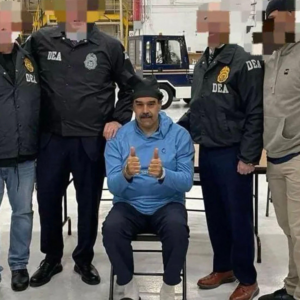
On 3 January, the United States launched a large-scale military operation inside Venezuela, involving coordinated airstrikes and a special forces raid in Caracas, the country’s capital.
According to US officials, the operation, codenamed ‘Absolute Resolve’, resulted in the capture of Nicolás Maduro – who has led Venezuela since 2013 and has been accused by organisations including Human Rights Watch and Provea of overseeing widespread corruption, human rights violations and narcotics trafficking – along with his wife, Cilia Flores. Both were subsequently transferred to the United States.
Washington says that Maduro is facing US federal charges related to drug trafficking and terrorism, and has justified the military operation as necessary to enforce arrest warrants and counter threats to US interests. The Venezuelan government has rejected this account, describing the operation as an illegal act of aggression and a violation of the country’s sovereignty.
Human rights organisations, including Amnesty International and International Service for Human Rights (ISHR), have raised concerns that the US action may have violated international law, including the UN Charter’s prohibition on the use of force against sovereign states. Under international law, such force is generally prohibited unless undertaken in self-defence or authorised by the United Nations.
This article examines the political, legal and geopolitical context behind the US operation, as well as the competing narratives surrounding it.
Harbingers’ Weekly Brief
Subscribe to the Harbingers’ Weekly Brief, a newsletter written by the editorial board of Harbingers’ Magazine, the world’s youngest newsroom, delivered to your inbox every Monday morning.
![slide image]()
![author_bio]()
![author_bio]()

Background to US–Venezuela conflict
US officials argue that Venezuela has long maintained links to armed groups such as Colombia’s FARC and the ELN, which Washington has designated as terrorist organisations and accused of trafficking large quantities of cocaine and other illicit narcotics into the United States.
The alleged presence of guerrillas within Venezuela reinforces the Trump administration’s claims that the country has become destabilised, unsafe and a potential threat to US national security.
US prosecutors allege that Maduro and senior figures within the Venezuelan regime have enabled or benefited from these networks, and these claims now form the US charges brought against him. Maduro denies the accusations and describes them as “politically motivated”.

Beyond narcotics-related allegations, US officials have pointed to Venezuela’s close political and economic ties with US rivals, particularly China and Russia.
It has been proven that Venezuelan oil revenues indirectly benefited governments and actors hostile to US interests, including Russia,Iran-backed proxies such as Hezbollah,and Cuba.Critics arguethat Caracas’s reliance on Beijing and Moscow has intensified as a response to growing international isolation and US sanctions.
Operation Absolute Resolve marked a sharp escalation in Washington’s long-standing pressure campaign against Caracas, reflecting a more confrontational approach by the Trump administration compared with previous reliance on diplomatic and economic measures.
The capture did not happen in isolation. In the preceding months, the United States increased its military presencein the Caribbean, deploying additional naval assets and expanding surveillance operations near Venezuelan waters as part of what officials described as counter-narcotics and security missions.
The expanded footprint signalled heightened operational readiness and set the stage for direct action.
US sanctions have also shaped Venezuela’s trajectory. Introduced in the mid-2000s, they initially targeted government officials before expanding in 2019 to restrict access to US financial markets and the oil sector, the country’s primary source of revenue. Critics say the measures deepened the economic crisis, while Washington argues they were intended to exert political pressure on the government.
Maduro’s influence on Venezuela
Maduro rose to power in 2013 following the death of Hugo Chávez, who governed Venezuela from 1999, inheriting the political project known as Chavismo, a form of left-wing populism that combined state control over key industries with strong opposition to the US influence in Latin America.
During Maduro’s tenure, Venezuela’s economy contracted sharply, a decline that economists attribute to a combination of fiscal policy choices, structural dependence on oil revenues and the impact of international sanctions.
Estimates indicate that poverty rose significantly during the years of Chávez and Maduro’s rule, although precise figures vary depending on methodology. Analysts have linked this increase to the mismanagement of Venezuelan nationalised resources, particularly within the oil sector, alongside high inflation and shortages. These factors left large segments of the population economically vulnerable as political power became increasingly centralised under Maduro’s leadership.
One long-standing policy introduced during the Chávez era was state-imposed price controls on basic goods. While initially intended to make essential items affordable, these controls often set prices below production or import costs. As a result, many producers reduced output or exited the market, contributing to widespread shortages.
This encouraged the growth of informal and black markets where goods were sold at prices far higher than official rates. This meant that low-income households – the intended beneficiaries of the policy – frequently struggled to access essentials such as food and medicine.
By 2025, around 80% of Venezuelan residents were living below the poverty line, limiting their ability to afford basic household necessities, including healthcare, housing and utilities.
As livelihoods eroded and access to basic services deteriorated, migration increasingly became a survival strategy rather than a choice. As of May 2025, more than 6.8 million people – roughly 24% of the population – had left Venezuela, making it one of the largest external displacement crises in the world.
Human rights in Venezuela
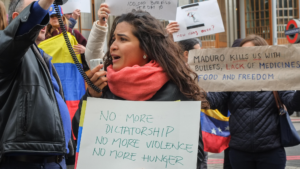
Maduro’s rule has been widely criticised by international human rights organisations for restricting political opposition, curbing press freedom and undermining judicial independence.
While protests against the Trump administration’s recent actions have taken place within the United States, public opinion among Venezuelans themselves remains divided.
View this post on Instagram
Some surveys suggest that Venezuelans who have emigrated are more likely to support external pressure on the government than those still living in the country. However, analysts note that polling inside Venezuela is constrained by censorship, surveillance and fear of reprisals, meaning people may be reluctant to express dissenting views openly.
Maduro’s record has been challenged by numerous watchdogs. The Financial Times has described him as a “lord of misrule” while the Organized Crime and Corruption Reporting Project (OCCRP) named him its “Person of the Year in Organized Crime and Corruption” in 2016, citing findings of systemic corruption and misuse of state resources.
At various points, more than 50 governments – including the US – have declined to recognise Maduro’s leadership.

Edited by:

© 2026 The Oxford School for the Future