


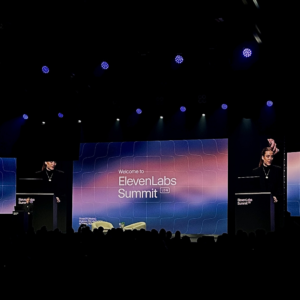
17-year-old Charlotte reports on the ground from the ElevenLabs Summit in London on the latest AI developments
House music, tech bros and a genuine interest for human connection. Those are just a few elements of the ElevenLabs Summit that took place in London on 11 February.
ElevenLabs, the AI company founded in 2022 by Piotr Dąbkowski and Mati Staniszewski, two Polish friends then in their twenties, wants to change the world – and it is already making a compelling case for why it might.
In under four years, ElevenLabs grew from a small startup into a company valued at $11bn, after raising $500m in a Series D funding round – a later-stage investment where investors provide significant capital to rapidly growing companies.
Harbingers’ Weekly Brief
Subscribe to the Harbingers’ Weekly Brief, a newsletter written by the editorial board of Harbingers’ Magazine, the world’s youngest newsroom, delivered to your inbox every Monday morning.
![slide image]()
![slide image]()
![author_bio]()
![author_bio]()


“The bottleneck is not technology any more, it is the deployment. The companies that ship, that learn and that scale quickly, are the ones that will win,” said Staniszewski in his keynote speech.
The company is recognised for AI voice technology that generates hyperrealistic, emotionally expressive speech in more than 70 languages, widely regarded as “the world’s most natural-sounding”. It has three main platforms: ElevenAgents, ElevenCreative and ElevenAPI, all available on a freemium basis.
The company’s mission is threefold: to build the most comprehensive audio AI platform in the world, to make all information accessible in any language and any voice, and to make interactions with technology as natural as those between people.
The London summit, themed “Voice of Technology” and attended by over a thousand people, was a window into how seriously that mission is already being pursued.
AI agent security
The concept of a genuinely authentic, human-like AI voice is both incredible and unsettling.
ElevenLabs has not been immune to this tension; the company previously faced controversy when claims emerged that its technology had been used to generate fake political voices during the last US election.
It is a serious issue, and one that goes to the heart of what makes voice AI so uniquely risky: unlike a chatbot, a convincing voice can deceive in ways that feel deeply personal.
Since then, ElevenLabs has taken what it describes as a landmark step. At the summit, the company announced a first-of-its-kind AI agent insurance policy developed with AIUC (Artificial Intelligence Underwriting Company) and its founder Rune Kvist.
The framework, AIUC-1, stress-tests the company’s AI systems by simulating more than 5,000 potential risks and misuse scenarios across data and privacy, safety, security, reliability, accountability and societal impact. This means that these AI agents and their actions can now be insured (like any other employee).
This suggests that the company recognises the responsibility that comes with what it has built. Whether these measures are enough remains a fair question, but the willingness to pursue accountability rather than avoid it marks a meaningful shift.
Creating with ElevenLabs
Luke Harries, head of growth at ElevenLabs, gave a live demo of ElevenCreative, the company’s platform that allows brands and marketing teams to go from idea to a full campaign in under a day. The platform combines speech, music, sound effects, image and video in a single interface, enabling studio-quality content production at a fraction of the traditional cost and timeline.

Such technology will undoubtedly transform the media we consume every day. It can reduce barriers and constraints which might have existed previously and allow for a quicker process. However, it also raises an important question: what will happen to our world’s creatives, such as directors, artists and video editors? Will this be a tool that enhances human creativity?
The summit was not only a showcase for what ElevenLabs can offer individuals; it also signalled where the company is heading institutionally.
ElevenLabs has launcheda dedicated government initiative designed to help public sector organisations deliver always-on services, expand equitable access and strengthen crisis response capabilities.
The company has already partneredwith Ukraine’s Ministry of Digital Transformation to deploy AI voice agents across public services at a national scale.
AI in marketing
The panel on AI in marketing revealed a shift that will be felt across industries this year. Stephanie Buscemi, chief marketing officer at Confluent, described organisations becoming structurally flatter, with AI taking on more of the execution layer.
Ketty Slonimsky, formerly chief growth officer at Palta (the parent company of women’s health app Flo), pointed to something easily overlooked in these conversations: taste, lived experience and wild imagination.
As AI handles more of the production work, what becomes genuinely scarce – and therefore more valuable – is a distinctive human perspective and the ability to make creative judgements that models cannot replicate.
Peter Gordon, chief innovation officer at WPP Open, agreed, noting that agentic AI is already reshaping back-office functions and that we need to lean into it now rather than wait.
Slonimsky also notably argued that “OpenAI will become one of the most powerful distribution platforms”, a new form of marketing that we are already beginning to witness. She also described 2026 as the year of “vibe working”.
Rethinking how companies operate
Ilkka Paananen, CEO of Supercell, the Finnish gaming studio behind Clash of Clans, Clash Royale and Brawl Stars, brought a different but complementary perspective. His stated goal is building games that people play for a long time and remember forever.
He runs Supercell through what he calls the “cell” approach: small, autonomous teams with the freedom to fail, a structure he says makes him the least powerful CEO in the world.
His broader philosophy, the “champagne approach”, is rooted in ambition: shooting for the moon, building things that do not yet exist, and treating failure as a necessary part of the creative process rather than something to be avoided. He was also candid about community, arguing that while everyone in the industry talks about it, genuine transparency is the only thing that actually builds it.
Sebastian Siemiatkowski, CEO of Klarna – one of Europe’s most prominent tech success stories – spoke during a panel about the importance of bringing young people into companies.
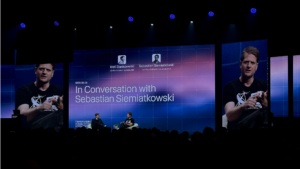
He argued that younger talent is the key to killing complacency at established companies, such as his own, where teams might otherwise stick to approaches they have been using for years.
Siemiatkowski also stressed the importance of putting a cap on the number of people working at a company, suggesting that they are undeniably more productive, driven and mission-oriented.
His final words of advice for those who are building now were simply: “Think about your customers and work your a** off.”
Real human impact
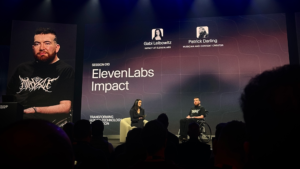
The most emotionally powerful moment of the day was a performance by Patrick Darling, a 32-year-old composer and former singer who was diagnosed with motor neurone disease (MND) at just 29.
Over the past few years, he has gradually lost the ability to sing and can now speak only a few words with difficulty. However, he took to the stage at the summit performing in his own voice, which was recreated using technology from ElevenLabs.
His family, who had not heard him sing since the progression of his illness, were in the audience to witness his return to performance.
View this post on Instagram
“It provides hope, support and meaning to people in ways that you can’t fully appreciate unless you’ve lived it yourself,” Darling said.
ElevenLabs has committed to providing free access to their technology for individuals experiencing permanent voice loss, as well as non-profit organisations across healthcare, education and culture.
The main takeaway from the summit was perhaps surprising given its theme: humanness, creativity and authenticity are still what matters most. Across every panel, demo and discussion, the most compelling moments were not about what technology could do on its own, but about what it could unlock in and for people.

Edited by:

© 2026 The Oxford School for the Future