



18-year-old Saanvi considers the problems, both financial and environmental, facing a business built on speed
It’s easy to understand why consumers might want to buy a sparkly top for just £5. The economics behind that, not so much.
Ultra-fast-fashion retailer Shein has built its business around a surprisingly simple idea: make a huge number of products, sell them cheaply, see what people buy, then make more of whatever works.
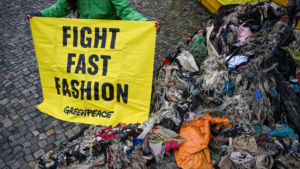
At its core, Shein relies on constant purchases of cheap, low-quality clothing. A customer buys a T-shirt or dress; three months later, they’ve forgotten all about it. Then they make a new purchase. This repetitive cycle means that the customer eventually amasses a large quantity of clothes that ultimately end up in the landfill.
The rise of the e-commerce giant, founded in China in 2008 and now based in Singapore, shows how algorithms and ultra-low prices have transformed fashion into a high-speed experiment.
Traditional fashion is a forecasting problem. Imagine a retailer deciding how many jackets to manufacture for next winter. They make that decision months before they know how popular the jackets will be. If it produces 100,000 but sells only 60,000, it is left with excess stock that may eventually have to be discounted or even thrown away. This creates not only a financial problem but also a waste problem.
View this post on Instagram
Shein approaches this problem differently. Rather than immediately producing huge quantities, it test products in relatively small batches and uses customer behaviour to decide which ones deserve greater production.
Instead of asking ‘What will consumers want six months from now?’, Shein asks, ‘What are consumers doing right now and what do they want next?’ A product that performs well can be scaled up, while one that fails can be dropped without leaving the company with thousands of unsold items.
The company’s feedback loop – data > prediction > small production > consumer response > new data – allows the company to make these decisions continuously. More information can mean better predictions, less inventory risk and less money tied up in products that might never sell.
This helps explain Shein’s appeal to investors. Reducing the amount of money tied up in unwanted stock while responding quickly to demand can support faster growth. Investors value companies partly according to what they expect them to earn in the future, so expectations about that growth matter enormously.
Shein is a good example of how quickly those expectations can change.
Times – and rules – change
Can a business model built on constant growth and consumption remain profitable as regulation, environmental costs and changing consumer behaviour put pressure on it?
In 2022, Shein was valued at almost $100bn by private investors. After failed attempts to list on the US and London stock markets, it finally floated on the Hong Kong Stock Exchange in August this year. It raised around $1.7bn at a valuation of roughly $26.5bn, a sharp decline from its previous private-market valuation.
The difference matters because valuation is based on expectations as much as current performance. For investors, the question is therefore not simply whether Shein can make money, but whether it can continue growing quickly enough to justify those expectations.
For years, one of Shein’s biggest advantages was its ability to deliver extremely cheap products directly to consumers. But this model depends on more than technology. It also relies on taxes, trade rules, transport costs, labour, materials and regulation.

A particularly important element is the treatment of low-value parcels entering major markets, such as the US. “De minimis” rules allow certain low-value shipments to enter a country without the full customs duties and procedures normally applied to imports.
Changesto the de minimis system in the US – since August 2025, goods valued at $800 or less are no longer exempt from tariffs – has made trade more expensive for online retailers such as Shein that rely heavily on shipping individual low-value packages directly to consumers. The company posted a loss of $99min the first three months of 2026.
The same is true of the European Union. The EU received 5.8 billion low-value parcels in 2025, an increase of 26% from the previous year, with more than 90% of them from China. Since then, the EU has introduced a €3 customs duty feefor goods worth less than €150, plus a €2 handling fee.
A business built around ultra-cheap, individually shipped products becomes much harder to operate when shipping, customs and regulatory costs rise. The advantage of speed can quickly become less valuable if the cost of delivering that speed increases.
Environmental concerns
Then there is the environmental problem.
Shein has argued that its small-batch approach can reduce inventory waste because products that do not sell are not then produced on a huge scale. But reducing unsold clothing is not necessarily the same as reducing environmental impact.
If technology makes it possible to produce clothing faster, more cheaply and in greater variety, consumers may simply buy more. This is related to the rebound effect: making something more efficient does not automatically reduce its overall impact if lower costs encourage greater consumption. In fact, Shein sells 1.9 billion garments per year.
The environmental cost is compounded by the greater output of clothing items resulting in an overall worse outcome for the climate.
For example, if technology reduces the environmental cost per item by 20%, but lower prices cause the number of items purchased to rise by 50%, the total environmental impact could still increase.
This connects to another economic concept: price elasticity of demand. Price elasticity measures how much demand changes with fluctuations in price.
With extremely cheap fashion, the financial barrier to buying another item is tiny, making additional purchases easier to justify. That creates a cycle of lower prices, more purchases and greater production. It fuels growth, but makes no efforts to reduce material consumption.
For investors, this creates a difficult trade-off. Shein has built an impressive business model capable of responding quickly to consumer demand and operating at enormous scale. However, tighter trade regulations, environmental pressures and changing consumer attitudes could increase its costs and challenge the appeal of its model.
These issues are not just ethical concerns; they can have direct financial consequences. Higher costs, regulation, changes in consumer behaviour and reputational damage can all affect a company’s profitability and long-term value. The key question for investors is therefore not simply, ‘Is Shein profitable?’, but ‘Can the economic model behind that profitability last?’
Shein’s success also highlights a wider contradiction between efficiency and sustainability. Improvements in technology and data have allowed businesses to make products faster, cheaper and more efficiently than ever before. Yet greater efficiency does not necessarily mean greater sustainability.
Harbingers’ Weekly Brief
Subscribe to the Harbingers’ Weekly Brief, a newsletter written by the editorial board of Harbingers’ Magazine, the world’s youngest newsroom, delivered to your inbox every Monday morning.
![author_bio]()
![author_bio]()


Algorithms can predict demand and reduce the risk of unsold stock, while finance can direct investment towards businesses with strong growth potential. But neither can determine how much we should ultimately consume. That is a question for society, not mathematics.
Perhaps the most important lesson from Shein is that speed has become a form of economic power. The faster a company can respond to consumers, produce products and adapt to new information, the more quickly it can turn uncertainty into profit.
The problem is that resources are scarce. What happens when an economy built around constant acceleration reaches the limits of the world around it?

Edited by:

© 2026 The Oxford School for the Future