Harbingers’ Magazine is a weekly online current affairs magazine written and edited by teenagers worldwide.
harbinger | noun
har·bin·ger | \ˈhär-bən-jər\
1. one that initiates a major change: a person or thing that originates or helps open up a new activity, method, or technology; pioneer.
2. something that foreshadows a future event : something that gives an anticipatory sign of what is to come.
We and our partners may store and access personal data such as cookies, device identifiers or other similar technologies on your device and process such data to personalise content and ads, provide social media features and analyse our traffic.
In a quiet neighbourhood of Seoul, two families live entirely different lives. One resides in a luxurious hilltop mansion surrounded by sunlight and space.
The other struggles in a cramped semi-basement apartment where the window reveals little more than street-level feet passing by. When Kim Ki-woo, the son of the indigent family, receives an opportunity to tutor the wealthy Park family’s daughter, a chain of carefully orchestrated deceptions begins. Step by step, the Kim family penetrates the Park household, by pretending to be strangers and securing a role within the home. What begins as a clever scheme gradually transforms into something darker, revealing tensions that were always present beneath the surface.
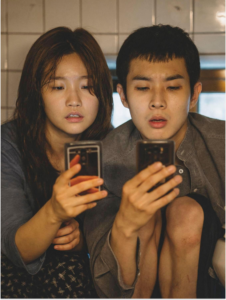
Parasite (2019), directed by South Korean filmmaker Bong Joon Ho, became one of the most celebrated films of the 21st century. The film stars Song Kang-ho as Kim Ki-taek, the struggling father who gradually becomes the driver for the wealthy Park family, whose employer is played by Lee Sun-kyun. Upon its release, Parasite captivated audiences around the world, eventually becoming the first non-English-language film to win the Academy Award for Best Picture.
With its mixture of dark humour, suspense and social critique, the film quickly achieved global recognition – at its core, Parasite offers a powerful reflection on class divisions and the invisible barriers that structure modern society.
The film presents inequality, not through speeches or political declarations, but through architecture and space. The Park family’s home stands elevated above the city, engulfed in natural light and carefully designed simplicity. On the other hand, the Kim family lives below street level, their apartment half underground, where even sun rays must fight their way through a small window. These contrasting spaces act as a visual metaphor for social hierarchy. One family looks down from above, while the other struggles to rise from below.
This spatial divide reflects a broader social reality. Economic inequality is not merely about income differences; it shapes daily life, opportunities and perceptions of dignity. The Kim family is intelligent, resourceful and determined, yet their environment limits the possibilities available to them. Their deception becomes not only a survival strategy but also a desperate attempt to access a world from which they are systematically excluded.
Harbingers’ Weekly Brief
Subscribe to the Harbingers’ Weekly Brief, a newsletter written by the editorial board of Harbingers’ Magazine, the world’s youngest newsroom, delivered to your inbox every Monday morning.
See you on Monday!
Ooops - please try again.
The title Parasite invites viewers to question who truly fits the label. At first glance, the Kim family appears to parasitically attach themselves to the wealthy household, benefiting from the Parks’ resources. However, the film gradually complicates this interpretation. The Parks, despite their kindness and politeness, rely heavily on the labour of others while remaining largely unaware of the struggles faced by those who serve them. Their comfort depends on an invisible network of workers whose lives remain hidden below the surface.
Through this ambiguity, Bong Joon-ho provokes audiences to reconsider simple moral categories. Rather than presenting villains and heroes, the film portrays individuals trapped within an economic structure that encourages exploitation and dependency. In this system, everyone participates, whether knowingly or not.
The story takes a dramatic turn when secrets hidden within the Parks’ mansion come to light, transforming the film from a clever social satire into a tense and tragic exploration of class conflict. What at first seemed like a clever scheme then spirals into utter chaos, through which the director might suggest that it takes more than cunning to move from one social class to another.
Despite being deeply rooted in South Korean society, Parasite resonates globally because the issues it addresses transcend national boundaries.
Across the world, urban landscapes increasingly reflect similar divisions, luxury apartments overlooking cities where many struggle to afford basic living conditions. The film, therefore, speaks to a universal distress resulting from the widening distance between the wealthy and the poor.
More importantly, Parasite forces viewers to confront uncomfortable questions. How much of social success is determined by effort, and how much by circumstances beyond our control? Or to what extent do modern societies permit the advancement on the social ladder? Furthermore, how often do those on top remain unaware of the realities faced by those below them?
Perhaps this is why the film continues to resonate years after its release. Much like the greatest works of social cinema, it does not simply entertain, it compels audiences to reflect on the structures that shape everyday life. Beneath its thrilling plot lies a simple yet unsettling idea, in a world defined by deep economic divisions, the line between opportunity and desperation can be thinner than we might like to believe.
Born in 2009 in Warsaw, Poland, Mateusz joined Harbingers’ Magazine to cover topics related to the upcoming Polish presidential elections
His interests include economics, physics, and art, which align with his plans to study engineering or architecture, preferably inthe UK or Italy.
In his free time, Mateusz enjoys all kinds of sports, with a particular passion for windsurfing. He also loves learning new skills (it brings him a sense of fulfilment and growth), admiring art in galleries and exploring other forms of artistic expression.
🌍 Join the World's Youngest Newsroom—Create a Free Account
Sign up to save your favourite articles, get personalised recommendations, and stay informed about stories that Gen Z worldwide actually care about. Plus, subscribe to our newsletter for the latest stories delivered straight to your inbox. 📲
We use cookies to ensure that we give you the best experience on our website. If you continue to use this site we will assume that you are happy with it.