Harbingers’ Magazine is a weekly online current affairs magazine written and edited by teenagers worldwide.
harbinger | noun
har·bin·ger | \ˈhär-bən-jər\
1. one that initiates a major change: a person or thing that originates or helps open up a new activity, method, or technology; pioneer.
2. something that foreshadows a future event : something that gives an anticipatory sign of what is to come.
We and our partners may store and access personal data such as cookies, device identifiers or other similar technologies on your device and process such data to personalise content and ads, provide social media features and analyse our traffic.
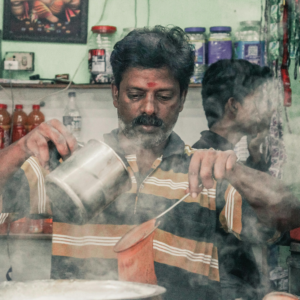
As an American of Indian descent, I have a bone to pick with Starbucks’ ‘chai tea latte’.
Chai(the Hindi word for tea), an infusion of black tea leaves, spices, milk and sugar, is an everyday drink consumed by millions of Indians. Its properties are backedby Ayurveda – a whole body system of medicine originating from ancient India – it is part of South Asian and Middle Eastern cuisines, and it even representsrebellion against British oppression.
So, when Starbucks attempted to claim a drink so unapologetically Indian and dilute it of its flavour, heritage and significance, I felt betrayed. Starbucks – and by extension, the West – has yet again colonised something so inherently Indian to provide a taste of ‘exotic’ Indian culture to the world without having to acknowledge its true origins.
And chai is not even the first target of Western gentrification of Indian culture. From the Eurocentric marginalisation of India’s involvement in the development of mathematics to the modern-day erasure of Indian heritage from yoga, a quintessential part of Hindu culture, the West has always looked for ways to steal Indian culture and claim it as their own.
On top of that, Indian immigrants are criticised for ‘not assimilating’ into Western culture, yet white people are celebrated and rewarded as the creators of practices that Indians are ostracised for doing.
In the West, yoga is often a commercialised fitness activity detached from its spiritual roots.
The concept of zero, the decimal numerical system, negative numbers, quadratic equations – and the list goes on – all come from ancient India. In the eighth century BCE, Baudhayana, a Vedic sage and mathematician, wrote the first Sulba Sutra regarding geometry for the construction of fire altars.
The work contains what we now refer to as the Pythagorean theorem, the approximate value for the square root of two, digits of Pi (π), and other formulas that Greek mathematicians later used for the foundations of geometry.
India has also been contributing to hygiene since 2500 BCE. Archaeological remains of the Indus Valley civilisation show evidence of drainage systems, private and public restroom facilities, water sanitation systems and aqueducts. Hygiene is heavily tied into ancient Indian culture and religion because bathing, hand and oral hygiene, and use of antiseptics was seen not just as public health and disease prevention, but as a necessity by society.
To explain how advanced this practice was, consider that Europeans and Americans didn’t buy into the concept of daily bathing until the 19th century when they finally realised that proper bathing and sanitation didn’t cause disease, but could actually be a tool against the spread of disease.
Harbingers’ Weekly Brief
Subscribe to the Harbingers’ Weekly Brief, a newsletter written by the editorial board of Harbingers’ Magazine, the world’s youngest newsroom, delivered to your inbox every Monday morning.
See you on Monday!
Ooops - please try again.
More than a trend
In the US, yoga and pilates is an industry worth $14.7bn and is not seen as the ancient Hindu practice of maintaining balance between the body, mind and spiritual self. It is a highly commercialised fitness activity devoid of any cultural integrity.
While Western power yoga has successfully captured every asana, or pose, and given it an English name, what people have failed to understand is that yoga consists of eight different aspects and the movements are barely one part. In India, yoga is not a common practice among the general public because it is seen as a highly religious and spiritual practice. In fact, yoga studios only began popping up in big Indian cities after it was popularised in the West.
Most people do understand that yoga has Indian origins, but don’t realise its full cultural significance. So you can enjoy getting a good stretch in your next yoga class, but remember that when your instructor feels the need to say namaste after every pose, you are merely partaking in a caricature of yoga.
I was just recovering from the shock of ‘chai latte’ when yet again, the West threw a punch – or maybe I should say, a ‘golden latte’ – in my face. The fix-all concoction my mom had been shoving down my throat for years was now all the rage at local grocery stores and café. But what is this new and magical ‘golden latte’?
Basically, turmeric (or haldi) and milk. And, trust me, there is nothing new about it. Indians have been using it for thousands of years. Turmeric, an incredibly important herb in Ayurvedic medicine, is believed to be tri-doshic or able to balance the three energies within the human body.
This checks out in terms of modern-day science too as turmeric is known for its anti-inflammatory and antioxidant properties. The global turmeric market is predicted to increase to $6.3bn by 2027.
But what the turmeric fanatics fail to realise is that the golden colouring they love in their milk is the same golden colouring that they judged in Indian cuisine.
The judgement didn’t end at just the food – it aimed to tear down anything remotely associated with Indian culture. Unless that practice could be stripped of its cultural identity.
Take hair oiling, the practice of massaging oils in one’s hair for growth, nourishment, and strengthening, yet another Ayurvedic practice that has been repackaged for Western consumption. Recently, it has been highly popularised over social media, also inspiring slickback hairstyles.
However, when South Asian immigrants used to do this they were often called “greasy” and “smelly”. You can surely imagine my surprise when some white girl on TikTok told me to put coconut oil in my hair, as if I wouldn’t have been bullied for doing the same thing just a few years ago.
Labelling these practices as “elevated”, “luxurious” and “sophisticated” while treating Indian people, who have preserved these practices and cultures, as second-class citizens only further perpetuates the narratives of inferioritypushed on to us.
There is no way to ethically practice Indian culture without understanding and acknowledging its origins. When the connection is lost and the appreciation turns into appropriation, it becomes colonisation of culture.
Indian philosophical ideas such as dharmaand karma and our fashionhave found themselves incorporated into the West. That is OK, because it represents how interconnected our world is. However, what needs to be discouraged is when important elements of culture are brought over and picked apart to only keep what is seen as acceptable to Western audience
Reva Sobti was born in 2008 and currently studies in the United States. She plans to pursue a higher education at one of the T-25 universities to major in Sociology, Business, or Biology. Reva won the Harbinger Prize 2024 and plans to continue writing about social issues.
After successfully completing the Essential Journalism course, Reva became a writer for Harbingers’ Magazine starting in March 2025.
In her free time, she loves to read, watch movies, bake, play volleyball, and eat good food. A fan of travelling, Reva has so far visited 16 countries.
🌍 Join the World's Youngest Newsroom—Create a Free Account
Sign up to save your favourite articles, get personalised recommendations, and stay informed about stories that Gen Z worldwide actually care about. Plus, subscribe to our newsletter for the latest stories delivered straight to your inbox. 📲
We use cookies to ensure that we give you the best experience on our website. If you continue to use this site we will assume that you are happy with it.