



Border tensions in this region have surfaced before. Thailand and Cambodia have had periodic disputes around sections of their border, particularly in the areas surrounding the Preah Vihear Temple. The skirmishes of 2008 and 2011 unfolded in much the same way, marked by patrols entering disputed zones and small incidents expanding into cross-border fire.
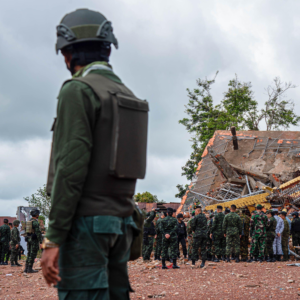
Soldiers on the Thailand/Cambodia border after a ceasefire was declared, August 2025.
For five days in late July, the frontier between Thailand and Cambodia saw its heaviest clashes in years.
Artillery fire hit villages and localities on both sides of the border, Thai F-16s carried out air operations, and ground forces exchanged shells across several points in the forested areas near Preah Vihear. Over the next five days, artillery and air strikes killedat least 38 civilians and soldiers and forced more than 300,000 residents from their homes. An uneasy ceasefire was declaredon 28 July.
Harbingers’ Weekly Brief
Subscribe to the Harbingers’ Weekly Brief, a newsletter written by the editorial board of Harbingers’ Magazine, the world’s youngest newsroom, delivered to your inbox every Monday morning.
![author_bio]()
![author_bio]()


Escalation along the border
The fighting began on 24 July after a landmine exploded near a disputed section of the border, injuring several Thai soldiers. Both governments were quick to blame the other’s forces for operating inside contested terrain, and the situation escalated quickly. Within hours, Thai and Cambodian units were exchanging artillery fire across multiple points along the border. Thai F-16s carried out air operations, while Cambodian forces, which lack comparable air capability, responded with ground-based weapons.
Shells struck villages, markets and several roadside facilities on both sides as the fighting widened. In Thailand’s Sisaket province, a petrol station was destroyed, causing several deaths. By the second day, exchanges of fire were being reported at more than a dozen points along the frontier, the most serious confrontation between the two countries in more than a decade.
The dispute centres on the area surrounding the 11th-century Preah Vihear Temple. Although the International Court of Justice awarded the temple to Cambodia in 1962, Thailand has long claimed land nearby.
As a result, the the area was never formally demarcated and sections of the frontier remain unclear, especially in dense forest along the border.
Patrols from both countries regularly operate in zones where claims to the land overlap. When the landmine detonated on 24 July, each government accused the other’s forces of crossing into its territory, contributing to the rapid escalation.
Experiences of those affected
As the exchanges continued, families in border villages began moving away from the fighting. Local officials on both sides reported steady evacuations from the first morning of shelling, with people leaving on foot, by motorbike and in small trucks.
By the third day, more than 130,000 people in Thailand had been evacuated, and Cambodian officials reported large-scale displacement. Estimates from humanitarian groups later suggested that the total number of displaced civilians across both countries exceeded 300,000. Authorities also confirmed civilian deaths and injuries, but figures varied across provincial reports.
“We were shocked, scared, but we had to get ourselves together,” said one Thai evacuee in Sisaket province. Another said: “It was so abrupt. At least here I can’t hear the blasts. At least here I have some peace of mind.”

Some residents returned briefly to assess the damage. Koon Kantho, 68, foundher home, which also served as a small grocery shop, destroyed. “Thank God, we fled,” she said.
On the Cambodian side, many families left villagesclose to the frontier as shelling intensified. “I miss my home,” said Chheng Deab, a displaced villager from Oddar Meanchey, who fled with relatives after the first blasts. Another evacuee, Chey Thavy, 56, describedrunning as explosions drew closer. “A bomb flew behind me when I was trying to run to a safe place. I felt terrified and couldn’t bring anything with me,” she said.
Conditions in temporary shelters on both sides of the border were basic. School buildings, pagodas and community halls were used as makeshift shelters, where families rested on mats and shared donated food and water. Many people also walked long distances to reach safer areas, carrying bags of clothing and holding their children as they moved away from the fighting.
Ceasefire
After five days of fighting, both governments agreed to a ceasefire on 28 July. The truce came with the support of ASEAN (the Association of Southeast Asian Nations – a regional organisation that promotes peace and stability in the region), as well as diplomatic pressure from international partners.
Thailand’s foreign minister emphasised the country’s stance during the ceasefire talks. “We will always stand firm and resolute in the defence of our sovereignty and territorial integrity,” he said. Cambodia must decide which path it will take – the path of peace and cooperation, or that of confrontation and loss.”
Cambodia’s Ministry of National Defence, backing the ASEAN resolution, stated that it wants its borders to be “frontiers of peace, friendship, cooperation and development”.
Five months after the ceasefire, the border remains calm but uneasy. Both governments have agreed to gradually reduce troop presence along key checkpoints, a step aimed at preventing further flare-ups. As of November, Thai and Cambodian officials have begun discussions to demarcate the border.

Edited by:

© 2026 The Oxford School for the Future