


16-year-old Irma interviews Dr Pramod Jaiswal, Rakshya Bam, Bikash Gupta, Dujang Sherpa and Bal Krishna Sah on Nepal’s geopolitics
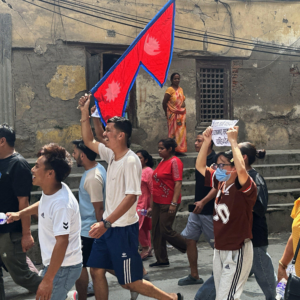
On 8 September 2025, Gen Z rose up against the Nepali government. A severe government crackdown resulted in the death of 76 Nepalis.
These killings sealed the fate of the ruling powers, as the nation poured on to the streets and overthrew Prime Minister KP Sharma Oli. In the following weeks, 45 young protestors were declared martyrs.
The events were tragic and seismic, sending significant ripples across the globe. I sat down with leading experts in Kathmandu to examine how the movement has affected Nepal’s position in the world.
These experts included Dr Pramod Jaiswal, research director at the Nepal Institute for International Cooperation and Engagement (NIICE); Rakshya Bam, a prominent figure in the Gen Z movement; Bikash Gupta, an eminent advocate at Nepal’s Supreme Court; Dujang Sherpa, former president of the Nepal Students Union; and Bal Krishna Sah, senior correspondent for the Himalayan Times (and head of our Nepali Newsroom).
Harbingers’ Weekly Brief
Subscribe to the Harbingers’ Weekly Brief, a newsletter written by the editorial board of Harbingers’ Magazine, the world’s youngest newsroom, delivered to your inbox every Monday morning.
![image]()
![slide image]()
![slide image]()
![slide image]()
![slide image]()
![author_bio]()


Gen Z protests
According to Rakshya Bam, the Gen Z uprising emerged from long-running frustration with corrupt power. Newspapers consistently broke stories of corruption, misused taxes and dwindling opportunities for employment. Ordinary people were ignored and neglected. “[Citizens] were suffering from basic things, basic facilities, basic rights,” she says.
This negligence of democracy continued to erode public life. Bikash Gupta acknowledges that frustration had been “piling up inside youths… over the last eight to ten years”. Though increasingly disillusioned by the government, Nepalis continued to live their lives without meaningful change.

Bal Krishna Sah, senior correspondent for the Himalayan Times, head of the Harbingers' Nepali Newsroom.
Then, after the government’s decision on 4 September to ban 26 social media platforms, Gen Z judged that a line had been crossed. They flooded on to Discord to express their disbelief and rage towards those in power.
Quickly, this online network transformed into “an unorganised, unstructured movement against the incompetent government,” Gupta says.
Since the overthrow, a new tide of transparency, accountability and accessibility has risen in Nepal’s politics. As Dujang Sherpa puts it, the Gen Z movement “changed the benchmark; it has broken the ice of current Nepali politics.” It showed politicians that “the youth cannot be tampered with and cannot be taken for granted”.
Geopolitics in the past
During the Cold War, Nepal, like many small countries, was a battleground for the ideological influence of the two great powers. After the USSR collapsed, a new competitive arena emerged around the country, as both India and China took interest in the nation.
As these neighbours industrialised and consolidated, the US also saw the importance of protecting their foothold in South Asia. “Whoever will rule over Asia will rule over the world, and whoever will rule over South Asia will rule over Asia,” Dr Jaiswal argues.
This strategic thinking led to intense competition for Pakistan and Afghanistan, but also to a lesser extent for Nepal. Dujang Sherpa suggests that this smaller country was often viewed as “a buffer state” between China and India.
From 1955, Nepal set in motion the principle of non-alignment. Rather than aligning itself with one major power, Nepal has historically sought to balance relationships with competing global actors.
“Nepal has critically maintained its position as a state that has non-aligned relations in all major world affairs or politically diverse questions that Nepal has to face,” says Gupta. Even today, Bal Krishna Sah notes, “Nepal sits in a very delicate geopolitical zone.”




Geopolitics today
Domestic affairs in Nepal have undergone a dramatic and sudden change since last September. Foreign policy is now largely in the hands of the country’s new prime minister, Balen Shah, former rapper and mayor of Kathmandu, and his foreign minister, Shisir Khanal.
Yet the priority of the government has been to meet the primary demands of the Gen Z movement. “Probably, he [Shah] thinks that his first task is to control corruption and good governance,” Jaiswal says. “One year, no distraction… one internal agenda.”
This suggests that the prime minister has deliberately placed foreign affairs behind domestic reform during the early months of his tenure. Khanal has made a few state visits, but has overall maintained existing norms – in particular, the norm of non-alignment.
Yet some aspects of the present administration seem unique. While the previous PM met ambassadors privately, the new head of state has refrained from doing likewise. “I think he wants to send a message to the superpowers… to increase competition for assisting Nepal in development work,” Sah says. “The move has been well accepted and celebrated by diplomats and Nepali people alike.”
Still, “there is continuity,” says Jaiswal.
“Nepal’s foreign policy will remain, whoever is in power, because we have two important neighbours, India and China. We are bound to engage with both.”
Relations with these two powers are worthy of a closer examination.
India
India remains Nepal’s closest and most intertwined partner. “We have very deep political, economic, cultural, historic and all kinds of relations with India.” explains Jaiswal. The two countries also share an open border.
However, the relationship is characterised by dependence. “We import 80%,” Jaiswal says, “and we hardly export [anything]… copper wire, tea, noodles and other minor things.”
These ties are not without occasional tensions. Recent disputes have emerged concerning the western border, taxation on imports and exports, and even the tea trade. As a result of a recent ban on Nepali tea imports into India, an estimated 99 tea factories across eastern Nepal were affected, leaving thousands of workers unemployed.
The incident highlighted the high stakes for Indo-Nepali relations under the new government. “If we don’t make diplomacy work with our neighbouring countries, then just like the tea [industry] was shut down, so a lot of other industries will also be shut down,” says Sherpa.
China
Former prime minister Oli had exceedingly strong relations with China, even breaking with convention to foster closer ties.
In spite of major internal change in Nepal, China cannot be ignored. The economic powerhouse accounts for 48% of foreign investment in Nepal in 2025–26, and has been perhaps the most proactive neighbour following the Gen Z uprising. “The Chinese have the highest engagement, the faster engagement,” Jaiswal suggests.

Yet a strong relationship with China is sometimes at odds with Nepal’s Gen Z agenda. In March, 21 individuals, among them two Chinese officials, were charged for the unauthorised use of exceedingly large sums. The Pokhara Airport caseis one of the most significant in Nepal’s legal history, and was heavily linked to Chinese involvement. It was the new government that exposed this scandal and brought the parties to account.
Nevertheless, Jaiswal rejects the idea that the new government is becoming less friendly towards Beijing. Although some believe the new administration is drawn to India and the West, he argues that China has continued to engage closely.
He points to initiatives such as the Chinese Youth Pioneer Programme,which China has used to build relationships with Nepal’s younger and ruling generation. This said, Sherpa notes that firm answers on Sino-Nepali relations have been slower to arrive.
Too early to tell
In spite of these powerful influences, the sway of foreign powers in Nepal should not be exaggerated. The Gen Z movement, for example, has sometimes been accused of originating overseas, particularly in the West. It is the belief of Jaiswal that such claims are based more upon perception than evidence. He explains that “in every political change that happens in this country which is related to communism, people see the Chinese hand.”
Similarly, he says: “If the Nepali Congress or the Democrats do something, they see Indian hands.” This suggests that political events in Nepal are often viewed through the lens of victimhood and impressionability, even where clear ties are absent.
Similarly, it is inadvisable to draw hasty conclusions on the course of the new government. All five interviewees agree on one point: it is still too early to judge the government’s long-term impact. Sherpa describes the current period as the administration’s “honeymoon period”: the first 100 days, in which the electorate steps back and watches for the fruits of change.
For this reason, some Gen Z revolutionaries, including Rakshya Bam, have declined invitations to join the new executive, preferring to act as a watchdog. In Bam’s own words: “I chose to be in the streets.”

© 2026 The Oxford School for the Future