


17-year-old Viola interviews activism coordinator Anna Horváth about Amnesty’s work
Founded in 1991, Amnesty International Hungary is the Hungarian chapter of the global human rights movement, working through advocacy, campaigns and education to defend human rights and promote equality.
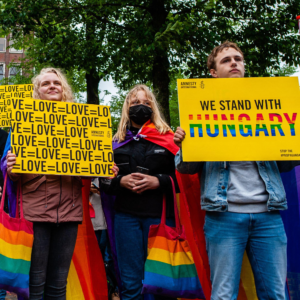
For years, they used to reach thousands of young people through school workshops on human rights. However, in 2021, Viktor Orbán’s government introduced the so-called “propaganda law”, which banned the portrayal or discussion of LGBTQ+ themes to people under the age of 18 in schools, educational materials and on TV.
Following the law’s implementation, Amnesty Hungary reduced the number of such workshops because teachers feared inviting NGOs into classrooms. Rather than working directly with students, Amnesty shifted its focus to training educators and youth professionals.
View this post on Instagram
“We changed the model a bit, and we started to invite teachers and other people working with young adults – for example, social workers working in schools – to training sessions,” Anna Horváth, Amnesty Hungary’s activism coordinator, said in an exclusive interview with Harbingers’ Magazine.
Today, the organisation continues to raise awareness about human rights and encourage young people to become more involved in addressing social issues, such as bullying, discrimination and gender inequality.
“We start education by heart, not by a textbook. You shouldn’t imagine our workshops as a class of 30 students sitting by their desks and listening to a teacher,” Horváth explained. Instead, the participants explore the topics through interactive games, discussions and drama-based educational methods.
Harbingers’ Weekly Brief
Subscribe to the Harbingers’ Weekly Brief, a newsletter written by the editorial board of Harbingers’ Magazine, the world’s youngest newsroom, delivered to your inbox every Monday morning.
![author_bio]()
![author_bio]()


The goal, she said, is to help young people realise their own connection to social issues and create an “open-minded future generation who respects human rights and actively stands up for them together”.
Fanni Csernus, a gender equality adviser at Amnesty Hungary, believes that striving for change can be really difficult for the youth, as stereotypes and social norms are internalised in children from early on.
She explained that traditional gender norms are reinforced from early childhood through stories and children’s books, toys and household chores, later influencing teenagers’ career aspirations, confidence and relationships.
“We need to realise that we all walk in the same shoes. Instead of being fragmented, we should start supporting each other and fighting collectively, so that our voices are less easily silenced,” Csernus said.
She thinks that in order to push for change and tackle social issues, young people need to challenge traditional gender roles rather than legitimising the conventional patriarchal system.
Finding community through activism
One of the main ways Amnesty Hungary tries to address gender inequality is through the FEL! project, whose name translates to “Shoot for Equal Opportunities”. This advocacy and training initiative aims to raise awareness about gender inequality in the workplace and promotes women’s rights through short-form Instagram and TikTok videos.
Teenagers join the project by filling out Amnesty’s activist application form, available on its website. Then they brainstorm and produce engaging social media content that is accessible and informative at the same time. The idea is that young women will know their rights in the labour market even before they submit their first CV.
Even after the three month-long project ends, many teenagers choose to stay involved with Amnesty, says Horváth, largely because of the strong sense of community. Some even encourage their friends to join the organisation’s activities – a response she described as one of the most rewarding aspects of her work.

“This way, you can not only transform your own and friends’ life, but also potentially influence the entire system,” added Csernus.
To sustain that engagement, Amnesty Hungary’s engagement department works closely with the youth activists and hosts regular workshops for them focusing on community building and on the skills essential for activism, from collecting signatures to organising events.
Throughout these sessions, Horváth tries to create an atmosphere in which young people are not afraid to share their dreams and ideas, ask their questions and voice their fears.
“In a world full of uncertainty, it’s important how we handle our frustration, and having a supporting community can be our greatest anchor,” she said.
Amnesty also teaches other skills such as discussing opposing opinions while remaining empathetic, and drawing connections between individuals’ personal interests and broader social issues.
“Having the constant curiosity to make new connections and engage with challenging ideas can be incredibly frightening at first. But young people need to let go of the shame of changing their mind, because at the end of the day it is only going to make them richer,” Horváth said.
Both Horváth and Csernus expressed hope regarding the recent election results, which ended Viktor Orbán’s 16 years in power and brought Péter Magyar’s pro-EU Tisza Party into government. They said they look forward to more constructive discussion between the state and civil societies.
In April this year, the European Court of Justice found Hungary’s “propaganda law” to be discriminatory and in breach of basic democratic values.

Edited by:

© 2026 The Oxford School for the Future