



logo

Harbingers’ Magazine is a weekly online current affairs magazine written and edited by teenagers worldwide.

harbinger | noun

har·​bin·​ger | \ˈhär-bən-jər\

1. one that initiates a major change: a person or thing that originates or helps open up a new activity, method, or technology; pioneer.

2. something that foreshadows a future event : something that gives an anticipatory sign of what is to come.

cookie_image

We and our partners may store and access personal data such as cookies, device identifiers or other similar technologies on your device and process such data to personalise content and ads, provide social media features and analyse our traffic.

20 February 2026

How Bali made me rethink the way we heal

author_bio
Lola Kadas in Bali, Indonesia

Article link copied.

slide image

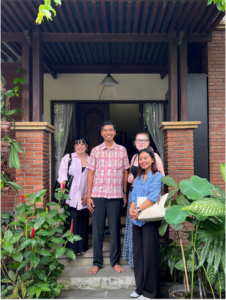
Lola (in glasses) outside the private Suryani institute with Dr Lesmana (centre).

Picture by: Harbingers' Project

When I first arrived in Bali last summer to report on attitudes towards mental health, I landed with a rough idea of what the psychological landscape might look like.

From my research, the most prominent issue I encountered was pasung– a grim custom in which families of those with severe mental conditions restrain them, sometimes chaining them inside rooms or even confining them to sheds outside.

The reasoning behind this practice is rooted in fear and a lack of knowledge. Family members are often frightened of the person who is struggling and have no adequate way of helping or caring for them. This led me to believe that the resources available for mental health support were very limited and not widely accessible.

While the issue of pasung is present, there was so much more about Balinese psychological approaches that I had yet to learn. The complex relationship between psychology and spirituality is what I found to be especially important.

It is true that a lack of widespread knowledge surrounding mental health can lead to misunderstandings. At the same time, it can also result in alternate ways of processing periods of emotional struggle. Many people I spoke to on the Indonesian island explained that whenever they feel overwhelmed or that their emotional well-being is suffering, they turn to temple visits or water purification ceremonies as a way to process these feelings.


In Bali, I had the chance to visit two psychiatric facilities. The first was Kopi Kental, a government-funded institution with no online presence where patients are mostly elderly and living in cramped spaces. There is no emphasis on talk therapy or spiritual practice; treatment is medication-based. The facility, which relies only on volunteers, is overcrowded and often has to turn away patients because it simply cannot accommodate them.

The second facility I visited was very different from Kopi Kental. The privately run Suryani Institute approaches mental health differently, using a combination of talk therapy, medication and spirituality to help their patients.

What really stood out to me was how clearly this place acknowledges that Western psychology can feel alienating to the Balinese. By using meditation – something that most Balinese people are familiar with – the institute is able to meet patients through a more culturally comfortable approach.

As a result, patients are more open to talk therapy, and when this is combined with medication, it leads to meaningful progress. I also appreciated the institute’s efforts to spread mental health awareness in Bali through community events and online activism.

This model, however, comes at a cost, making care less accessible to many Balinese who cannot afford private treatment.

Coming from a background where mental health is usually addressed through diagnosis, medication and therapy sessions, this approach felt unfamiliar but eye-opening. In the West, we try to “fix” everything quickly, whereas in Bali there is more patience.

The Balinese believe that healing takes time and that emotional pain is part of a longer journey rather than a problem to be erased immediately.

This approach does, however, carry certain risks. When mental health is seen solely through the lens of spirituality, serious conditions might be misunderstood or dismissed. Some people may believe that prayers or rituals are enough and consequently delay medical treatment that may be urgently needed.

This means that there is no single best approach when addressing mental health struggles. Effective treatment requires an understanding of the individual and their cultural background. The Suryani Institute leads the way in demonstrating how Western and local Balinese practices can work together. This gives me hope that progress will continue and that meaningful support will reach those who need it in Bali.

Leaving the island, my understanding of mental health felt far more complex than when I arrived. I still believe in the importance of medication and therapy, but I also recognise the value of patience, community, kindness and spirituality as part of healing. Bali challenged the idea that there is only one “right” approach to mental health. It reminded me that sometimes healing begins not only with a prescription, but with connection.

Written by:

author_bio

Lola Kadas

Society Section Editor 2025

Budapest, Hungary

Born in 2009 in Budapest, Hungary, Lola has lived in Budapest and California, US. She is interested in music, pop culture, politics, and mental health, and plans to study psychology.

Lola joined Harbingers’ Magazine in the summer of 2024 as a contributor during the Oxford Pop-up Newsroom. After completing the newsroom and the Essential Journalism Course, she became a writer in the autumn of the same year, covering society and public affairs. Her strong writing skills and dedication to the magazine led to her promotion to Society Section Editor in 2025.

In her free time, Lola plays guitar, piano, and volleyball, enjoys going to concerts, and creates various types of studio art. She is also a fan of Taylor Swift’s music.

Lola speaks English, Hungarian, French, and Spanish.

Edited by:

author_bio

Arnav Maheshwari

Economics Section Editor 2025

Georgia, United States

opinion

🌍 Join the World's Youngest Newsroom—Create a Free Account

Sign up to save your favourite articles, get personalised recommendations, and stay informed about stories that Gen Z worldwide actually care about. Plus, subscribe to our newsletter for the latest stories delivered straight to your inbox. 📲

Login/Register