



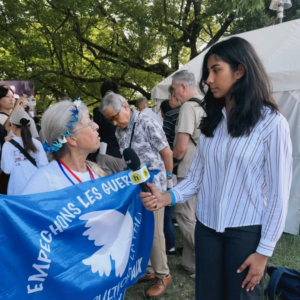
17-year-old Reva interviews journalist and academic Norito Kunisue on Japan’s role in global conflict resolution
On 6 August 1945, the United States dropped the atomic bomb ‘Little Boy’ on the Japanese city of Hiroshima, followed three days later by the ‘Fat Man’ bomb on Nagasaki. The bombing led directly to the loss of 100,000 lives, but the devastation persisted as the resulting radiation contributed to the deaths of an additional 100,000 people.
Japan formally surrendered on 2 September and has since committed to peace. The country’s new constitution went into effect on 3 May 1947, with Article 9 renouncing Japan’s sovereign right to war.
Today, Japan is a strong advocate for nuclear disarmament through its Hiroshima Action Plan and in hosting the 2023 G7 summit in Hiroshima.
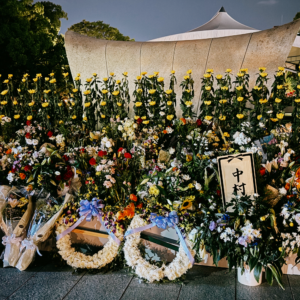
The peace ceremony marking the 80th anniversaryof the Hiroshima and Nagasaki bombings made evident their lasting impact on Japanese communities and the world. The ceremony was also a warning about how deadly the price of war can be and urgent cry for the world to look for peace.
However, it is also important to build an understanding of war from the perspectives of war victims; this is crucial to conceptualise war as more than a violent manifestation of politics.
In an exclusive interview with Harbingers’ Magazine, Norito Kunisue, journalist and project professor at the Research Center for Advanced Science and Technology at the University of Tokyo, shed further light on this issue.
Kunisue has been a journalist for more than 36 years covering international policy, European politics, religion and global security.
He told Harbingers’: “I believe that the atomic bomb survivors of Hiroshima and Nagasaki have long been the ones who have made war victims visible.” He credits his holistic perspective on war reporting to working with atomic bomb survivors (known as hibakusha). He encourages others to take the same approach.
“The perspective of the victims contains elements that seek justice in war. The establishment of the International Criminal Court marked a significant advancement in incorporating the victims’ perspective into international politics, as it was the first international tribunal to recognise the status of victims and allow them to participate in trials,” he explained.
“The victims of the atomic bombs have long advocated for the importance of this perspective. Their appeals have not only addressed the issue of nuclear weapons, but have also influenced the way we think about war.”
Support for Ukraine
At this time of heightened global tensions, including Russia’s war on Ukraine and the Israel–Palestinian conflict, it is more important than ever for Japan to take a strong stance against militarisation.
Kunisue, who has reported on the frontlines of the Ukraine conflict since Russia’s full-scale invasion in 2022, asserts, “For Japan, which has limited military capabilities, a rules-based international order is a principle that must be upheld above all else, and therefore it cannot condone Russia’s behaviour. Japan should clearly state its position in support of Ukraine, and the Japanese government has maintained that stance to date.”
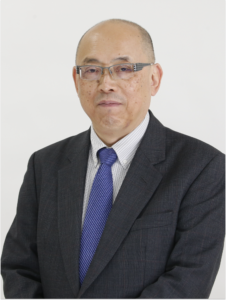
Norito Kunisue.
Kunisue is committed to reporting in Japanese “to tell the true story of Ukraine to our government and society”.
Sanae Takaichi became the first female prime minister of Japan in October 2025. Shortly afterwards, she reaffirmed Japan’s unwavering support of Ukraine in a call with President Zelenskyy. Japan has provided humanitarian and financial aid to Ukraine’s war efforts and will provide support to the country’s energy sector to aid cities through winter.
In addition to his hopes for the Japanese government’s involvement in global diplomacy, Kunisue urged young people to stand up. He expressed his surprise at the lack of outrage against Russia’s threats of nuclear warfare. “If [the youth] fear nuclear weapons, they should raise their voices and take action against specific moves.”
Nuclear dilemma
Despite Japan’s outward opposition to war and nuclear threats, the country finds itself in a difficult position.
“When Japan advocates disarmament and non-proliferation in the field of diplomacy, many countries find it difficult to oppose it… because the voices of the atomic bomb survivors have the power to appeal to public sentiment,” said Kinisue.
However, Japan is unable to use the voices of survivors to urge for total prohibition of nuclear weapons because it falls under the US nuclear umbrella, due to the Treaty of Mutual Cooperation and Security signed between the two countries at the conclusion of World War II.
Japan’s recently recommitted to its three non-nuclear principles – not possessing, not producing and not permitting the introduction of nuclear weapons into the country (although it did permit the US to store nuclear weapons in Japan during the Cold War).
According to Kunisue, “Japan can play a sufficient role in spreading awareness of the devastation caused by nuclear weapons to the international community and promoting widespread recognition of the illegality of nuclear weapons” even if they cannot fight for outright abolition.
Harbingers’ Weekly Brief
Subscribe to the Harbingers’ Weekly Brief, a newsletter written by the editorial board of Harbingers’ Magazine, the world’s youngest newsroom, delivered to your inbox every Monday morning.
![author_bio]()


Alliance with the EU
Japan and the US have remained strong allies since the end of World War II. However, Kunisue argues that “with the establishment of the Trump administration in the United States and the loss of the common values that Japan and the US once shared, cooperation between Japan and Europe must be further strengthened.”
One method is the EU-Japan Strategic Partnership Agreement, agreed in 2019, which is a “shared commitment to strengthen the rules-based global order and enhance global governance”, according to the EU’s official statement.
The EU and Japan have promised to cooperate on preserving international peace and democracy by dealing with economic and political issues such as terrorism, weapons of mass destruction, nuclear risk, organised crime and corruption. This pioneering agreement establishes a precedent of collaboration between these major global powers and could lead to a future of allyship against nuclear weapons.
In this new era of war and conflict, Kunisue argues that it is more important than ever for Japan to remain firm on its stance of nuclear disarmament and to create a sense of global urgency for nations to follow through with their distancing from nuclear weapons.

© 2026 The Oxford School for the Future