


17-year-old Matthew analyses the enduring legacy of the the Kennedys via the buzz surrounding the TV series ‘Love Story’
The United States of America was founded at a time when monarchies were the dominant system of government. To differentiate itself, the union rejected the concept of hereditary rule, with the Constitution explicitly stating that “no title of nobility shall be granted by the United States”.
Yet for many, the Kennedy family of Hyannis Port, Massachusetts is widely considered “American royalty”, given the immense wealth and political influence its descendants have wielded since the first Kennedy landed in Boston after fleeing the Great Famine in Ireland in 1849.
In particular, John Fitzgerald Kennedy, the 35th president – known as JFK – and his immediate family have left a regal legacy, one that continues to live on today.
Harbingers’ Weekly Brief
Subscribe to the Harbingers’ Weekly Brief, a newsletter written by the editorial board of Harbingers’ Magazine, the world’s youngest newsroom, delivered to your inbox every Monday morning.
![slide image]()
![author_bio]()
![author_bio]()


In recent months, the family have found themselves in the limelight once again, thanks to the buzz surrounding Glee and American Horror Story creator Ryan Murphy’s new TV show Love Story.
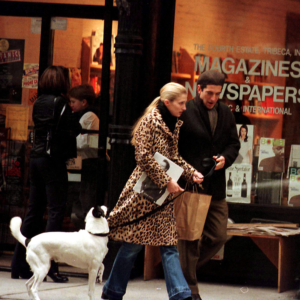
This anthology series explores fictionalised stories of real-life couples, with the first season focusing on the whirlwind courtship, rocky marriage and eventual tragedy of JFK’s son, John F Kennedy Jr, and his wife Carolyn Bessette Kennedy.
The return of ‘quiet luxury’
Social media, in particular, has been obsessed with the couple’s style and essence. Prior to their tragic death in a plane crash in 1999, aged just 38 and 33, John and Carolyn were perhaps the most stylish power couple of the decade.
John’s wardrobe consisted of Armani and Ralph Lauren suits mixed with Levi’s jeans, gym shorts, seasonal sets of preppy knitwear and, of course, his iconic Yankees baseball cap worn backwards. By his side, Carolyn sported oversized Prada coats, Yohji Yamamoto pieces, simple black turtlenecks, washed-out jeans paired with oval-shaped shades, wide tortoiseshell headbands and worn-in penny loafers.
They collectively defied flashy hip-hop fashion, redefining ’90s style as effortless urban minimalism with a hint of refined elegance. They were, in other words, the pioneers of what we now know as “quiet luxury”.
Since the release of Love Story in March, Google searches for “Carolyn Bessette style” increased by a whopping 150%, while numerous TikTok creators recreated John’s iconic “relaxed prep” outfits in clips that have amassed up to 1.3 million views.
The outcome? An increase in sales for some of the couple’s most beloved products. CO Bigelow, the Greenwich Village pharmacy where Carolyn bought her signature Charles Wahba headband, sold over five figures worth of the hair accessory in one weekend. Luxury eyewear brand Selima Optique, maker of her $750 Aldo sunglasses, reported a similar surge.
At a JFK Jr lookalike contest, hundreds of New Yorkers gathered at Washington Square Park in John’s signature suit and backwards cap combination, garnering mass attention on mainstream outlets such as InStyle Magazine.
The root of John Jrand Carolyn’s appeal today is based on two things: his father’s legacy and our nostalgia for the past.
President Kennedy and Camelot
JFK’s two year-long presidency – tragically cut short by his assassination in Dallas in 1963 – is one of the most popular in US history. A recent YouGov survey found that Kennedy is the second most popular president, just after Abraham Lincoln.
His presidency is often described as “Camelot”, a term coined by his wife Jacqueline (Jackie) Kennedy in reference to the mythical medieval castle and court of King Arthur. This glorifies the Kennedy presidency as a brief period of optimism, akin to King Arthur’s rule of wisdom and benevolence.
Jackie Kennedy first drew the connection between the legend and her husband in an interview with LIFE Magazine’s Theodore White after the assassination. Jackie mentioned how Camelot, the Broadway musical, was her husband’s favourite production, and that he was particularly drawn to the closing lyrics: “Don’t let it be forgot, that once there was a spot, for one brief shining moment that was known as Camelot.”
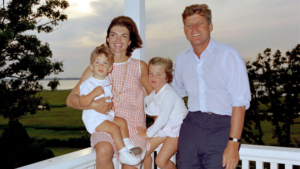
President Kennedy and his wife were, in comparison to their predecessors, energetic and progressive, with art and culture, in particular, thriving during their time in the White House.
The couple established commissions and initiatives to support living artists and pioneer the development of the creative industries. The first lady hosted state dinners, concerts and cultural galas that showcased and celebrated the crème de la crème of American performing arts.
Americans remember JFK as a handsome, charismatic and youthful statesman with a sophisticated, fashionable wife who wore brightly coloured coats and pillbox hats.
Though what truly cemented their legacy were the well-curated images that spoke louder than actions. The many photographs of him and his children sailing or playing touch football romanticised the first family’s image in an intimate manner that amplified their vim and vitality.
At 43, he was also the youngest-ever president elected to office. After a decade of the ageing Eisenhower leadership, the Kennedys stood out as a radical departure. They effectively became the paradigm of American life, just as royal families do in established monarchies.
The unforeseeable loss of President Kennedy amplified the mythical narrative – despite unflattering realities such as the Vietnam War and the Cuban missile crisis – as America mourned the loss of an idyllic and charming leader.
To quote his grieving widow’s remarks, “There’ll be great presidents again… but there will never be another Camelot.” The assassination was seen as the end of a hopeful era, as the presidency’s potential was forever lost.
View this post on Instagram
A regal legacy and its heir
At the 1963 funeral procession for his father, three-year-old John Jr honoured the fallen president in a crisp salute to the coffin. The sight of the toddler in his light blue coat paying tribute moved the millions who were watching on television, and permanently defined his image as a living extension of the lost legacy.
Thirty years later, John Jr’s life of glitz and glamour only reinforced this powerful imagery of Camelot, as the country projected its collective nostalgia on to “the prodigal son”. He and Carolyn became the embodiment and symbolic custodians of the golden times, playing a role reminiscent of his parents’.
The Johns, both father and son, left the world with unfulfilled potential with their tragic and early deaths, freezing them in time, a reminder of what could have perhaps been greater. Through Love Story, we are eternally reminded of the enduring Camelot legacy, and its lasting promise of political chivalry and exceptionalism.

Edited by:

© 2026 The Oxford School for the Future