


17-year-old Mutaz explores the world of hobby politics through the world’s micronations
Seven miles off the coast of England lies a rusting metal platform the size of a football field called Sealand. It contains infrastructure, hosts internet services, runs on renewable energy and even has a jail.
In some ways, it resembles a real country. However, it is not officially recognised by any state in the world. Today, it is one of the best-known early examples of a micronation.
Harbingers’ Weekly Brief
Subscribe to the Harbingers’ Weekly Brief, a newsletter written by the editorial board of Harbingers’ Magazine, the world’s youngest newsroom, delivered to your inbox every Monday morning.
![slide image]()
![author_bio]()
![author_bio]()


What is a micronation?
A micronation is an entity that claims to be an independent state, but whose sovereignty is not recognised by the international community.
It should not be confused with a microstate, which are extremely small but properly recognised countries, such as Monaco or Liechtenstein.
When was the first micronation founded?
There is no exact date for the creation of the first micronation, as historical exceptions and debates make it difficult to identify a single starting point.
However, the Islands of Refreshment, founded in 1811 by American sailor Jonathan Lambert on the Atlantic island of Tristan da Cunha, is considered a strong contender. Captain Lambert arrived with two other seamen and claimed the island as his own. He planned to form a settlement and economy based on seal products.
These plans ended when Lambert and one of his companions drowned at sea in 1812. The British annexed the island in 1816.
How have micronations evolved?
There are many reasons why people decide to start a micronation. Some are created for fun or personal interest, while others are formed as a protest against existing political systems. In practice, very little is required to start a micronation beyond publicly declaring its existence.
All micronations claim to be sovereign, but they differ widely in how they operate. Some attempt to function like real states, issuing laws, stamps and currencies and creating a national flag. Others take a more humorous or symbolic attitude. Some combine both approaches.
This variation reflects how micronations have evolved over time, often influenced by broader historical and cultural developments.

In the 18th and 19th centuries, micronations were often ambitious political projects. In the 1960s, “raft” nations such as Sealand and Rose Island – which was located on a concrete platform off the coast of Italy – became popular due to the influence of anarchism on the counter-culture movement.
In the 1970s, many Australian micronations such as the Principality of Hutt River and the Independent State of Rainbow Creek emerged as protests against local authorities.
Several Japanese villages created micronations to promote rural tourism in the 1980s. They were inspired by the best-selling book Kirikirijin, which portrayed a small village in northern Honshu declaring itself independent from the rest of Japan.
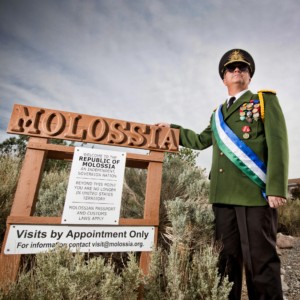
Satirical micronations include the tiny Republic of Molossia, located in Nevada in the US and founded in 1977. Molossia claims it is still at war with East Germany, and its ruler has an absurdly long title: “His Excellency President Grand Admiral Colonel Doctor Kevin Baugh, President and Raïs of Molossia, Protector of the Nation and Guardian of the People”.
In the 1990s, the fall of the Soviet Union inspired artistic micronations in the former Eastern Bloc that focus on philosophical attitudes rather than legal laws, and creating communities.
One example is the Republic of Užupis in Lithuania. Located in Vilnius’s old town, it covers an area of less than 1 sq km and has its own president, government, currency and (tiny) navy. Its constitution is translated into different languages and displayed on a wall on the aptly named Avenue of Constitutions.
The internet has significantly increased public awareness of micronations. Online videos and communities have helped bring the concept into mainstream culture,
Micronations have also appeared in popular media. For example, in one episode of the US animated sitcom Family Guy, Peter Griffin creates his own country, Petoria. The Netflix movie Rose Island (2020) is based on the story of Italian engineer Giorgia Rosa, who built his own artificial island nation of the same name off the coast of Rimini in the 1960s.
How do governments respond?
Historically, governments have responded to micronations in different ways. Many, such as Užupis or the Principality of Seborga in Italy, are largely ignored. This is due to the fact they pose no threat to the sovereignty of their respectful “host-nations”, and they promote local tourism. Other micronations, however, face legal consequences.

For instance, in the 1860s, Frenchman Orélie-Antoine de Tounensfounded the Kingdom of Araucanía and Patagonia in Chile. He allied with local Mapuche tribes and tried several times to muster arms for them. He was arrested on numerous occasion by the Chilean authorities and eventually deported back to France.
There are rare examples of recognition. In 2023, the Joseon Cybernation, a crypto-backed digital monarchy with no territory, was officially recognisedby the Caribbean nation of Antigua and Barbuda. Both parties signed an agreement that supports education, economic investment and other developmental initiatives and provides the basis for longstanding friendly relations.
In recent years, as micronations have gained more visibilityonline, there have been occasional claims of recognition. However, such cases are limited or disputed and should be treated with caution.

Edited by:

© 2026 The Oxford School for the Future