Harbingers’ Magazine is a weekly online current affairs magazine written and edited by teenagers worldwide.
harbinger | noun
har·bin·ger | \ˈhär-bən-jər\
1. one that initiates a major change: a person or thing that originates or helps open up a new activity, method, or technology; pioneer.
2. something that foreshadows a future event : something that gives an anticipatory sign of what is to come.
We and our partners may store and access personal data such as cookies, device identifiers or other similar technologies on your device and process such data to personalise content and ads, provide social media features and analyse our traffic.
Following the Gen Z protests last September, Nepal has had a temporary government under interim prime minister Sushila Karki.
The major goal of the current administration is to hold elections in order to bring a new government into office and restore a full parliamentary system after the dissolution of the previous government.
The election was originally planned for 2027, but is now scheduled for 5 March 2026. It will elect the 275 members of the House of Representatives, the lower house of Nepal’s federal parliament.
Nepal uses a mixed voting system: 165 members will be elected through first past the post (FPTP), while 110 will be elected through proportional representation. As of 20 January, 3,486 candidates across Nepal are contesting for the 165 seats, 396 of them being women.
Nepali citizens within Nepal who are 18 years or older are allowed to vote. Voters get two ballots, one to vote for a candidate in their local area and one to vote for a political party.
Harbingers’ Weekly Brief
Subscribe to the Harbingers’ Weekly Brief, a newsletter written by the editorial board of Harbingers’ Magazine, the world’s youngest newsroom, delivered to your inbox every Monday morning.
See you on Monday!
Ooops - please try again.
As of early December, 114 political parties have been approved by Nepal’s election commission to participate in the elections.
The major political parties are the Nepali Congress (a centre-left party), the Communist Party of Nepal (Unified Marxist-Leninist), the Rastriya Swatantra Party (RSP) and the Rastriya Prajatantra Party (RPP). The RSP is a centrist party, while the RPP is a constitutional monarchist and Hindu nationalist party.
During the previous election in 2022, the Nepal Congress was the largest political party. After the Gen Z revolution last year, many new political parties were formed and registered. Nepali people are frustrated with old parties and leaders, and now they hope that the new political parties that support the agenda of Gen Z will come up and lead Nepal.
Balendra Shah, known as Balen,has attracted massive attention due to his maverick style and popularity among youth voters.
The 35-year-old rapper and former mayor of Kathmandu Metropolitan City is the prime ministerial candidate for the RSP party, and most young Nepali people want him to become the new PM. He has also challenged KP Sharma Oli, CPN-UML president and former three-time prime minister, in his constituency Jhapa-5, in eastern Nepal.
Nepal is likely to see interesting competition between the established parties and the new Gen Z parties. Voting allows people to express their opinions and choose the kind of future they want for Nepal. A fair and successful election can bring political stability, which is necessary for peace, progress and a better future for the country. Thus, the March election is very important for Nepal.
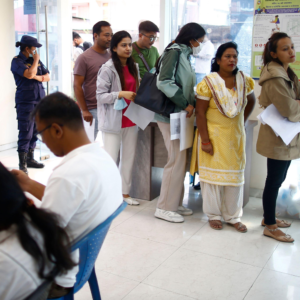
Citizens who spoke to Harbingers’ Magazine about the upcoming election have mixed feelings. Some support old leaders, while many expressed solidarity with young leaders.
Brothers Rajeev Sah, 18, and Sanjeev Sah, 16, said that young leaders should win as they are educated and understand the feelings of the youth, particularly after the Gen Z revolution.
“We are rooting for Balen Shah in the election as he has already proved himself as the mayor of Kathmandu Metropolitan City,” they said. “He respects and carries the agenda of the Gen Z movement. He is also representing the youth spirit in the election.”
Some voters are wary of change. Krishna Manandhar, 26, said: “Although there is a wave of young faces and new leaders, I do not trust them due to their lack of experience in politics and the system.”
Lal Bahadur Nepali, 71, also highlighted the weakness of emerging leaders and called them inexperienced. “I will vote for trusted and old leaders rather than new ones,” he said.
However, Soniya Tamang, 21, said that a new face should be elected. “I am hoping that Balen Shah wins the election,” she said.
Born in 2010 in Bajura District in Nepal, Samuna studies in grade six in Kathmandu, Nepal. She is interested in journalism and plans to study journalism in the future. She is part of our Nepali Newsroom’s Intermediate group and writes about politics and tourism.
In her free time, Samuna enjoys dancing, cooking, reading and listening to music. She is the first girl in her class and she has won several awards in various competitions organised by her school including dance and games.
🌍 Join the World's Youngest Newsroom—Create a Free Account
Sign up to save your favourite articles, get personalised recommendations, and stay informed about stories that Gen Z worldwide actually care about. Plus, subscribe to our newsletter for the latest stories delivered straight to your inbox. 📲
We use cookies to ensure that we give you the best experience on our website. If you continue to use this site we will assume that you are happy with it.