



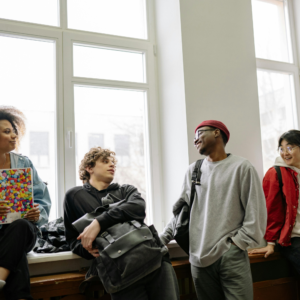
17-year-old Camille interviews three teenage girls with unique cultural mixes to understand how differences can cohabit
I go to an international school in Copenhagen, so I have gotten acquainted with a lot of mixed-race children. I’ve noticed that the different worlds they inhabit are often mixed up, resulting in some unique habits and traditions. As I am also the beneficiary of multiple cultures – my father is Syrian, my mother is French and I grew up in Denmark – I am very interested in these cultural mashups.

Abella, 18.
How do they show in people’s everyday life? Which traditions, foods and practices do they create? Let’s find out by meeting three high-school students: Lina, Sofia and Abella.
Lina is 17 and her parents, from Morocco and Palestine, migrated to Denmark as children. Lina spent most of her childhood in Dubai before moving back to Denmark. She speaks Arabic (Darija – Moroccan Arabic), English and Danish.
Sofia is also 17 and her parents are Finnish and Colombian. She was born in Finland and moved back and forth between Peru, Finland and now Denmark due to her parents’ jobs. She speaks Finnish, Spanish and English and understands Danish well.
Abella is 18 and was raised in Denmark. Her mother is French, her father is Danish, and she speaks French, English and Danish fluently, plus a little bit of Spanish.
Festivals and food
Lina and her family celebrate Eid and Ramadan. Whether in the United Arab Emirates or in Denmark, they cook traditional Moroccan food. Her dinner table is filled with dishes smelling of turmeric, paprika, cumin and coriander, without forgetting the amazing aroma of atay (mint tea). Among them is tajin (a slow-cooked meal of meat and vegetables) and djaj mhamar (roasted chicken with olives and lemon) and fries.

In Sofia’s family, the main holiday celebrated is Christmas. They start the day with traditional Finnish porridge with jam. The rest of the dishes during the day depend on which side of the family they are celebrating with – they vary from Latin American soups to Finnish ham and vegetable spreads.
Abella’s Christmas celebrations are also split up between two countries and cultures. If she is with her French family, for dessert they will eat a traditional bûche de Noël (yule log), bringing some delicious chocolate to end the dinner. They also celebrate Epiphany (6 January) with a traditional galette des rois (king’s cake), in which a little figurine is hidden. Everyone has a slice, and whoever finds the figurine is crowned king or queen.
If Abella is having a Danish Christmas, her family likes to have risalaman, cinnamon-flavoured rice pudding with a hidden almond. The person to find the almond gets a present, making for competitive eating contests in her family!
TV and music
TV shows are a huge part of childhood, and they reflect how the girls were brought up. Lina watched English cartoons such as Mickey Mouse Clubhouse, but she was also a fan of Baraem in Arabic and Bamses billedbog in Danish.
Sofia watched a Finnish show called Pikku Kakkonen and later other English shows such as My Little Pony and Winx.
Abella used to watch movies in French, a Danish children’s channel called Ramajsang and all the Barbie movies in French. Later, she started watching English shows on Netflix.

Lina, 17.
In terms of music, they now have playlists that are varied and full of different moods and languages. Lina has four playlists, one of them containing mostly Arabic songs, especially Dystinct, and another one with Danish songs from Lord Siva, Annika and Anton Westerlin. Her last two playlists are in English, and contain rap, pop and 2000’s music.
Sofia’s playlists are also organised by language, dedicated to Latin American or Finnish songs, but she also has “Arab, French and Turkish music” and, of course, some American classics such as Frank Ocean and Lana Del Rey. She also creates lists by vibe or mood, and mixes languages in these playlists.
Abella has decided not to listen to any music lately and has given away her headphones and Spotify membership (and confesses being very happy this way!).
Fashion
Lina follows “UAE street style” with a Danish twist, but always wears a gold necklace with her name on it in Arabic calligraphy, a gift from her grandparents. For weddings and celebrations, she goes all out and wears a beautiful kaftan – a traditional long dress – with ornaments and bright colours.
Sofia explains: “It’s difficult to wear Latin American style clothing in cold countries like Denmark, especially as vibrant clothes of that nature aren’t sold here.” She describes her style as a blend of Scandinavian and Pinterest outfit inspiration.
Abella grew up in a very international school and says it helped her wear what she liked, and not what most would expect. She takes inspiration from all her cultures, and others.
Harbingers’ Weekly Brief
Subscribe to the Harbingers’ Weekly Brief, a newsletter written by the editorial board of Harbingers’ Magazine, the world’s youngest newsroom, delivered to your inbox every Monday morning.
![image]()
![author_bio]()
![author_bio]()


Language
When Lina talks with her family, she mixes Danish, English and Darija in almost every sentence, even short ones. With multiple different language influences within Arabic, she mixes dialects such as Maghrebian, Arabian Gulf and Levantine. She also mixes languages with her friends who speak some of the same ones she does, and often uses expressions in different languages, adding her own spice to any conversation.

Sofia, 17.
Sofia uses the same methods to communicate with her family: both of her parents speak Spanish and Finnish, creating a unique mix of sounds at home. She studies in English, adding yet another language to her mix. She switches between Spanish and English very fast with her Latin American friends, and likes to use Danish words in her sentences similarly to Lina.
Abella uses the same language mashups with her siblings, saying: “We would often say full sentences in Danish but prefer a French word and just use it in sentences as if it made sense to anyone other than us.”
She says that English is much more fluid when talking about certain subjects, such as her emotions. For all three, each language has a specific role in their expression, and helps them communicate who they are.
Edited by:

© 2026 The Oxford School for the Future