

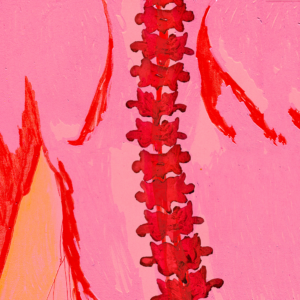
17-year-old Luvella explains what happened after she was diagnosed with scoliosis – a twisted spine – in 2020
Many people hear the word “scoliosis” in passing, maybe as a joke about someone’s posture, or a casual comment forgotten as quickly as it’s spoken. They think it’s just about standing up straighter – but they don’t realise that it’s so much more.
Scoliosis is an abnormal, side-to-side curvature of the spine, often forming an ‘S’ or ‘C’ shape, that twists the vertebrae (bones in the spine) and affects 2–3% of the population in the United States. But statistics don’t capture what it actually feels like to live with.
Harbingers’ Weekly Brief
Subscribe to the Harbingers’ Weekly Brief, a newsletter written by the editorial board of Harbingers’ Magazine, the world’s youngest newsroom, delivered to your inbox every Monday morning.
![image]()
![author_bio]()
![author_bio]()


My story began like so many others, in a doctor’s office with a quick bend-over test and a casual diagnosis.
I was 12 in 2020, when the doctor said, “You have slight scoliosis”, as if checking a box on a mandatory health assessment. No explanation. No discussion about monitoring. Just a note on a paper, and then life continued. Except the problem was still there. Over the next three years, my body kept trying to tell me something.
I was a tennis player who loved being outdoors, but I couldn’t understand why breathing sometimes felt like work. Why does my back always ache? Why sitting up straight felt exhausting, like holding a heavy weight. I noticed the unevenness in my waistline every time I put on a swimsuit during Hong Kong summers.
I saw it in the mirror, one shoulder higher than the other, and it bothered me constantly. I tried exercises, hoping I could fix whatever was wrong. I wore different clothes to hide it.
I didn’t know then that some things can’t be fixed with effort alone. Then, in late 2024, a chest infection hit me hard, hard enough that I ended up in the hospital struggling to breathe. They took an X-ray of my chest, and that’s when they found it: a significant curve in my upper back (the thoracic part of the spine). Suddenly, that forgotten doctor’s appointment came rushing back. But how could my “slight curve” have gotten so much worse?
Soon after, I got a proper spinal X-ray. The results stopped us cold: an S-shaped spine with a 47-degree thoracic curve and a 31-degree lumbar curve.
My family and I spent the next three days in a fog of worry, staring at images of my twisted spine, not knowing what it meant for my future.
When we finally met with an orthopaedic specialist, the curves had shifted again: 53 degrees and 26 degrees. It was the first time I realised that even the numbers weren’t absolute. Each doctor measures slightly differently; this is standard practice, but it left us confused and grasping for certainty.
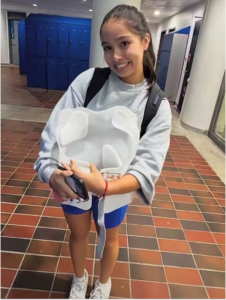
Luvella with her brace to halt the progression of her spinal curves
But with one thing, the doctor was clear. With my bones fully mature – at Risser stage 5, meaning no growth remaining – surgery was the only option. Spinal fusion. One of the most painful surgeries a person can undergo. They would permanently connect my vertebrae with rods and screws, stabilising my spine but limiting my mobility forever.
We saw ten more doctors. Most said the same thing, though their measurements kept varying slightly, which only added to our uncertainty. But I wasn’t ready to accept that.
The other path was bracing, wearing a hard plastic shell for 17 hours a day. Everyone told me it wouldn’t work, not at my age (I was 16 by then), not with my curvature. Bracing was for growing spines, they said. At best, it might slow progression. Improvement? Nearly impossible.
Nearly impossible. Not completely impossible. I chose the impossible.
My experience of bracing
The regimen was brutal: two different braces, one for the day and one for the night. I rearranged my entire life around them. Tennis, the sport I loved, had to go. Every hour out of my brace was an hour I couldn’t afford to lose. I saw friends less. I went outside less. I bought new clothes to hide the brace pressing against my body. I became a full-time patient.
On top of that, there were appointments everywhere: physical therapy, chiropractors, traction, and Schroth therapy. This specialised method uses three-dimensional exercises to de-rotate and stabilise the spine. The hours piled up. The exhaustion piled up. And through it all, there were no guarantees.
Then came the setbacks. My first brace didn’t work properly. An in-brace X-ray showed disappointing correction. Three more months passed before we found the right fit: a Rigo-Cheneau brace designed specifically to address spinal rotation. Three months of a critical treatment window, lost to trial and error.

But once I had that brace, things began to shift. There were days I questioned everything. I’m someone who struggles to work hard without seeing results, and everyone around me kept saying improvement would be a miracle. The doubt was loud. The routine was exhausting. The brace was uncomfortable in Hong Kong’s heat, hidden under clothes that never felt quite right.
But I kept telling myself that whatever happened, I would know I tried everything. Even if I eventually needed surgery, I would face it without wondering “what if”. In December 2025, after about a year of bracing, I got my follow-up X-ray. I had 22 degrees of improvement (47 to 25) in my thoracic curve. And 19 degrees (31 to 12) in my lumbar. The impossible had happened.
I’m still bracing now, slowly reducing my hours but keeping my night brace. Medical professionals warn me that maintenance will be hard, that my curve could revert. And they’re right. Scoliosis is a lifestyle, not something you cure and forget. I’ll always need to be careful, always need to maintain my exercises, and always need to respect what my body carries.
Advice for other sufferers
But I’m so glad I took the time I had to improve it as much as possible. To anyone reading this who might be walking a similar path, please understand scoliosis. Learn everything you can. And before you accept the most invasive option, explore whether there’s another way. Bracing is hard. There’s no sugarcoating that. It’s uncomfortable and inconvenient and sometimes lonely. But it deserves a chance.
View this post on Instagram
Most importantly, get multiple opinions. In my journey, consulting with multiple doctors wasn’t about finding someone to tell me what I wanted to hear. It was about truly understanding my condition from every angle, especially when their measurements didn’t always match. Each consultation taught me something new.
And do your research. If I had simply accepted the first recommendation or stopped with my first failed brace, my story would be completely different. Instead, I learned that sometimes the “impossible” path is the one worth taking, especially with all the support I had, thank you, mom. The one that asks everything of you and gives back more than you ever expected.

Edited by:
© 2026 The Oxford School for the Future