



17-year-old Ava interviews teenage girls about their reactions to the latest release of the Epstein files
Trigger warning: This article mentions sexual abuse.
In January 2026, the US Department of Justice released the final tranche of records relating to the Jeffrey Epstein sex trafficking scandal, marking the latest development in a years-long investigation. The disclosures made headlines in the media across the world and have sparked conversations about misogyny, power and justice.
Over more than a decade, US financier Jeffrey Epstein trafficked and abused hundreds of girls and young women, many between the ages of 14 and 17, across the United States and abroad. Federal records identify more than 1,200 victims and their families, though the true number is likely higher.
Harbingers’ Weekly Brief
Subscribe to the Harbingers’ Weekly Brief, a newsletter written by the editorial board of Harbingers’ Magazine, the world’s youngest newsroom, delivered to your inbox every Monday morning.
![slide image]()
![author_bio]()
![author_bio]()


The abuse, spanning from the late 1990s through the 2000s, followed a consistent pattern: girls were recruited with promises of money, modelling opportunities or travel, then isolated, manipulated and coerced into sexual acts. Many were flown to Epstein’s private island in the Caribbean, where, survivors later said, passports were taken and movement was controlled.
The scope of these crimes did not emerge all at once. Early accusations were dismissed, and it took over 20 years of investigation for survivors to be heard. Among the first to speak publicly were Maria Farmer and Virginia Giuffre, whose testimonies helped establish patterns of abuse and encouraged others to come forward.
As more accounts surfaced, investigators began connecting cases and revealed a broader trafficking network. Still, the process remained slow and incomplete.
Jeffery Epstein was first arrested in 2008 and ultimately served just 18 months in prison on prostitution-related charges, despite allegations involving under-age girls. More than a decade later, he was arrested again in 2019 on federal sex trafficking charges, but killed himself in prison before he could stand trial, leaving many questions about accountability unresolved.
View this post on Instagram
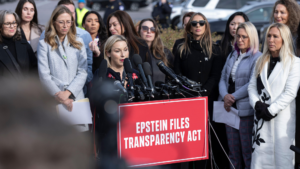
The Department of Justice has been severely criticised for its handling of the Epstein files. The final release of more than 3.5 million files – including roughly 2,000 videos and 180,000 images – was meant to provide transparency, but instead exposed some survivors’ identities, which triggered harassment, threats and renewed trauma.
Survivors such as Danielle Bensky said the release felt like a “slap in the face”, underscoring how the consequences of Epstein’s crimes are not confined to the past but continue to unfold in real time.
Discussing power dynamics
Harbingers’ Magazine interviewed teenage girls in the US who represent the demographic most vulnerable to the crimes of sex trafficking and sexual abuse that are central to the Epstein investigation.
The girls expressed frustration, not only with the details of the case, but with how it was allowed to continue for decades. They also said the case made them question whether the systems meant to protect victims actually function as intended.
For them, this case does not feel distant. “The ages, definitely,” one 17-year-old girl, who asked to remain anonymous, said. “Realising how young some of the victims were makes it feel a lot closer to us, not just something distant,” she added.
Lila, 17, emphasised how long the abuse went unchecked. “It confirmed something people already kind of believe… that if someone has enough power, things can get hidden for a long time,” she said.
The girls also pointed to the impact beyond individual victims, noting how cases like this shape how families think about safety and trust. The sense of vulnerability remained consistent across interviewees. The same anonymous student said the case made her more aware of how easily situations can escalate.
At the same time, they questioned power dynamics and gender-related disparities. Jordyn, 18, pointed to how influence shapes outcomes.
“Not just legally, but socially… like who gets believed, who gets attention, and who doesn’t. It feels like power doesn’t just protect people, it kind of controls the narrative around what actually happened,” she said.
They girls doubt that the justice system treats all cases equally when power and influence are involved. Together, their responses point to the same belief: power does not just influence outcomes, it determines whose voices are heard.
For these teenagers, the Epstein case is not just about what happened, but about what should change and whether systems will protect victims of similar abuse in the future and ensure they are taken seriously.
To date, no additional individuals connected to the case have been charged apart from Epstein and his partner Ghislaine Maxwell (who is currently serving 20 years in prison). Corroborating evidence is a complicated process, according to experts.

Data from RAINN (Rape, Abuse & Incest National Network) underscores how widespread these concerns are. In the United States, an estimated 443,635 people aged 12 and older experience sexual violence each year. Every nine minutes, that victim is a child.
Young people face the highest risk: 69% of victims are between the ages of 12 and 34, and girls aged 16–19 are four times more likely than the general population to experience sexual assault. Women and girls are disproportionately affected: 1 in 6 women in the US has experienced attempted or completed rape, and 82% of all juvenile victims are female.
Placed alongside these figures, the concerns raised by the girls interviewed by Harbingers’ reflect broader realities across the US. The scale of sexual violence, combined with the length of time it took for Epstein’s crimes to be fully recognised, continues to shape how young women understand power and accountability.
As the Epstein investigation continues, the focus shifts from exposure to response: whether institutions will act differently when confronted with similar abuses, and whether accountability will extend beyond individuals to the systems that allowed it to continue.
If you or someone you know has been a victim of harassment and/or sexual assault, the RAINN National Sexual Assault Hotline has trained support specialists that can provide support 24/7 in English and Spanish. It is a US-based service, but can be accessed globally.
Alternatively, the NO MORE Global Directory offers information on domestic and sexual violence helplines and specialist support services in most countries.
Please contact them, you are not alone.

Edited by:

© 2026 The Oxford School for the Future