


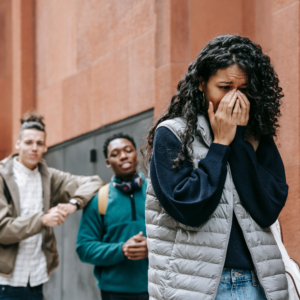
17-year-old Sofia examines how slut-shaming impacts the lives of young girls
Most girls, at some point, have been called a slut. It’s happened to me more times than I can count, and it’s happened to a lot of my friends too.
Not long ago, I found out I’d been casually labelled that in a conversation I wasn’t part of. No one involved had meant it as a serious insult, at least not exactly. As it was later explained to me, the word had been used “more as an observation”.
What stayed with me wasn’t necessarily the word itself, but its casualness. The label had circulated so easily that nobody seemed to question why it was being used at all.
Harbingers’ Weekly Brief
Subscribe to the Harbingers’ Weekly Brief, a newsletter written by the editorial board of Harbingers’ Magazine, the world’s youngest newsroom, delivered to your inbox every Monday morning.
![slide image]()
![author_bio]()
![author_bio]()


When asked if he ever used the term “slut”, 16-year-old Leo from Ondara said: “I guess I have. But I’ve never meant to humiliate someone. It came up in conversations with my friends, so it was hard to avoid.”
He also remarked that his friends use it regularly: “It’s normalised, I think. They often don’t mean it as an insult, it’s more like a habit.”
The language sounds casual enough that questioning it can feel like overreacting, even to the people affected by it.
What makes slut-shaming difficult to challenge is how normalised it is. Comments are rarely framed as something rude or disrespectful; more often, they are supposed to be jokes, observations or harmless gossip.
That is part of what makes slut-shaming difficult to identify in its modern form. It rarely looks dramatic, yet the consequences are real because the label conditions girls’ behaviour and limits the amount of freedom they feel they have.
The word itself has existed for centuries, although not always with the meaning it carries today. In Middle English, “slut” referred more broadly to someone (usually a woman) considered dirty or untidy before gradually becoming tied to morality and sexuality.
What remained consistent throughout those changes was who the judgement targeted. Even as the meaning shifted, the word continued to be used to police women’s behaviour or insult them.
View this post on Instagram
Maria’s experience
In a 2023 study on young women’s experiences of slut-shaming conducted by researchers at the University of Palermo, one participant described being perceived as a slut “just like that, at first sight”, before anyone actually knew anything about her.
The experience was presented less as an isolated incident and more as something we’re all familiar with – an example of how easily these labels can attach themselves to girls, often without explanation.
The label rarely relates to what a girl has actually done. More often, it appears through association: who she was seen with, what someone heard at a party, how often she goes out, the clothes she wears, or simply the tone someone uses while describing her.
In many cases, the accusation is vague enough that it can’t quite be disproven, yet specific enough to shape perception. This is partly what allows the word to travel so easily. It’s detached from any clear definition, so it becomes less about behaviour and more about social positioning.

“I like to wear short skirts in summer, especially to parties and stuff. And last year I was called a slut for that by a group of girls,” said 17-year-old María from Vergel. “They tried spreading rumours about me too.”
When asked if her experience made her feel that she should dress differently, María said she had never acted on such thoughts. “People get bored quickly, so all that slut-shaming will go away faster if ignored. If I dress differently, it’ll give them more to talk about,” she said.
She added: “I’ve actually learned to take ‘she looks like a slut’ as a compliment sometimes. Some jealous girls say it because they find you pretty, you know?”
Social conditioning
In Spain, especially in smaller towns, social circles overlap and people grow up around the same classmates, bars, neighbourhoods and so on. Information moves quickly. A comment made once at a party can continue circulating months later, repeated by people who were never there in the first place.
Reputations rarely disappear completely. For many girls, that possibility is what controls their ordinary decisions long before anyone actually says anything out loud They quickly learn that reputation is something fragile – something other people can construct for them through things like rumours, assumptions or repeated comments, even if said half-jokingly.

Many girls are highly aware of how they are perceived long before anything actually happens. Decisions about what to wear, where to go, who to stand next to at a party, or how openly to talk about relationships are all things we must often filter through the possibility of being talked about afterwards.
The awareness is integrated into daily life to the extent that it actually stops feeling unusual and becomes normal. I’ve seen my friends change outfits before leaving the house because something felt “too much”; and I’ve heard conversations where pre-teen girls warned each other not to “give the wrong impression”.
Over time, the effect becomes cumulative. When girls grow up constantly self-monitoring, they begin adjusting their behaviour. They avoid situations that might attract attention or invite unwanted commentary, and that conditioning can become very exhausting very quickly.
The fact that so many girls immediately understand this experience the moment it’s described says something on its own. Even if the situations differ slightly from town to town or person to person, the pattern is the same: reputation is unevenly distributed, and girls face a level of social conditioning that boys rarely experience in the same way.

Edited by:

© 2026 The Oxford School for the Future