


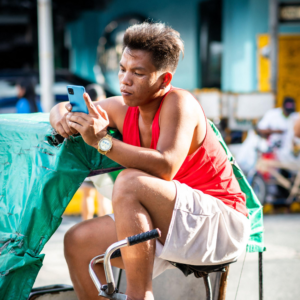
18-year-old Ryleigh Lemsic examines why people in the Philippines are turning to social media for their news
The first thing most Filipinos see when they check the news in the morning is no longer a print newspaper or a traditional TV screen, but a social media feed. According to the Reuters Institute’s Digital News Report 2025 for the Philippines, 66% of Filipinos turn to social media for news.
The Reuters report also found that overall trust in news has slightly increased, from 37% in 2024 to 38% in 2025. However, trust in the traditional institutions – individual media brands – that deliver it has started to erode.
For example, the rating for ABS-CBN, one of the most prominent mainstream news outlets in the Philippines, dropped from 64% to 60%, GMA News from 72% to 67%, Philippine Star from 65% to 61%, and Philippine Daily Inquirer from 66% to 63%, all in just one year.
Ryeonne Garcia, a 15-year-old Filipina, says she is often bombarded with current news when opening her social media apps.
She told Harbingers’ why people like her use social media for updates: “They’re usually faster and easier to access. News reaches me through my feed before I actively look for it.”
She emphasised that the accessibility, speed and convenience of consuming news through social media had led her to rely on it as her primary source of information.
Ryeonne represents the wider Filipino public who are continuously exposed to and consuming more news than ever – just not from journalists.
Corruption fuels scepticism
Recent senate hearings concerning rampant government corruption have resulted in growing scepticism of mainstream news outlets. Allan Lemsic, 48, explained how these factors have made him more distrustful of mainstream news’ accuracy and truthfulness.
“It’s highly possible that the media is bribed,” Lemsic says. He points to the specific example of GMA News journalist Arnold Clavio, who is alleged to have received bags of cash from disgraced former politician Zaldy Co. Clavio has denied the claims, but Lemsic remains sceptical, citing other incidents.
“Just observe the news and see the headlines they propagate most. Even [prominent broadcaster] Karen Davila from ABS-CBN admitted that some companies and institutions offer reporters cash to do their bidding,” he told Harbinger’s.
Ironically, distrust in mainstream news outlets hasn’t necessarily led the public to find more reliable alternatives. Social media has been found to produce rampant misinformation and disinformation due to the platforms’ inherent structure, which incentivises users to share as much information as possible.
Furthermore, the Reuters report stated that “information disorder” in the form of misleading narratives and political attacks has surged on social media. This is particularly true when it comes to the long-running feud between the political camps of President Bongbong Marcos and his vice-president Sara Duterte (whose impeachment trial has just opened in the Senate).
View this post on Instagram
Consuming news responsibly
Several mainstream media organisations have launched campaigns to rebuild their credibility with the public. By strengthening their fact-checking initiatives and setting up transparent mediums for citizens to report on details, they are hoping to regain the trust of citizens.
For example, GMA Network, the country’s largest media organisation, launched Panata Kontra Fake News (Covenant Against Fake News), a multiplatform campaign in partnership with more than 50 newsrooms, academic institutions and the Commission on Elections (COMELEC).
The award-winning campaign spreads awareness on ways to fact-check news online through its published fact-checks across social media and flagship projects. These include a fact-checking masterclass during the 2025 national and local elections that reached more than 12,000 people.

Harbingers’ Magazine reached out to notable Filipino news outlets for their statements on the Filipino public’s growing scepticism and distrust towards mainstream news outlets, but have yet to receive a response.
This growing distrust comes with a rising responsibility to navigate news critically. Media literacy, fact-checking and comparing information across multiple sources are increasingly important habits in the digital age.
Herchel Martinez, 54, told Harbingers’ that she avoids misinformation by cross-checking new stories through established and reputable news sources. “We should do our due diligence. With the advent of AI, the line between real and fake news is very thin,” said Herchel.
In a digital world, the challenge is no longer to find news, but to learn how to separate verified reporting from misinformed noise. Increasingly, the responsibility falls on the consumer to correctly discern truth from lies.

Edited by:

© 2026 The Oxford School for the Future