

17-year-old Mikołaj explains why, in Vietnam, closeness to political power matters more than who owns a company
In Vietnam, it is possible to live much of your life inside a single company.
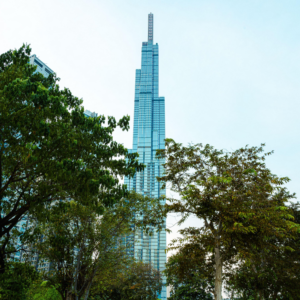
You can be treated in a Vinmec hospital, attend a Vinschool, live in a Vinhomes apartment, holiday at a Vinpearl resort and drive a VinFast electric car. From July 2027, you should be able to watch football at the 135,000-seat VinFast Stadium in Hanoi, which is expected to be the largest stadium in the world.
All of these belong to Vingroup, Vietnam’s largest private conglomerate – a group of companies working in very different industries but owned by one parent firm. Its founder, Pham Nhat Vuong, is the country’s richest man. He made his first fortune in the 1990s selling instant noodles in Ukraine, before bringing his money home.
Harbingers’ Weekly Brief
Subscribe to the Harbingers’ Weekly Brief, a newsletter written by the editorial board of Harbingers’ Magazine, the world’s youngest newsroom, delivered to your inbox every Monday morning.
![slide image]()
![slide image]()
![author_bio]()
![author_bio]()


Yet, Vietnam is a one-party state, governed by the Communist Party of Vietnam. The Party calls the country’s system a “socialist-oriented market economy”, where private companies compete for customers, but the state keeps what an official Party document describes as the “leading role”.
So for anyone outside Vietnam trying to understand a company like Vingroup, the first question seems obvious: is it really a private company, or is it run by the state?
That question is misleading and here is why. On paper, Vingroup is entirely private, but in Vietnam what shapes the fortunes of a big company is less about who owns and more about how close it stands to political power.
View this post on Instagram
An idea from China
The argument that ownership can give a false picture of who really controls a company comes from research on China. In 2015, two American law professors – Curtis Milhaupt of Stanford University and Wentong Zheng of the University of Florida – published a paper called ‘Beyond Ownership: State Capitalism and the Chinese Firm’.
“State capitalism” means an economy with markets but where the government still plays a significant role in business – most obviously through state-owned enterprises (SOEs), companies that the government owns. Most analysts had treated China’s version as simply a story about SOEs.
However, Milhaupt and Zheng disagreed. They argued that the Chinese state controls its own companies less, and private ones more, than ownership suggests. Large, successful firms of both kinds look strikingly alike: they dominate their markets, receive state subsidies, stay close to power and carry out government policy.
Their explanation is “capture”: instead of the state owning firms, firms win overthe state, building connections with officials to obtain benefits only the state can give.
Five years later, China showed how much power the state holds over private firms. In 2020, regulators halted the record-breaking stock market debut (IPO) of Ant Group, controlled by Alibaba founder Jack Ma, shortly after he publicly criticised the regime.
Milhaupt and Zheng’s paper covered only China. Vietnam is a natural test: it too is run by a Communist Party that opened its economy to markets – through reforms called Doi Moi (‘renovation’), launched in 1986 – while keeping tight political control.
What Vietnamese firms say
Vietnam has an unusual tool for testing this. Every year since 2005, the Vietnam Chamber of Commerce and Industry has run the Provincial Competitiveness Index (PCI), a survey that asks thousands of companies how local governments treat them. Its research has long been led by Edmund Malesky, a political scientist at Duke University in the US.
The PCI asks private firms whether officials favour certain kinds of companies.
Between 2015 and 2018, 41% said in any year that local governments favoured SOEs, while 49% said they favoured foreign companies. But the share who saw favouritism towards san sau or “backyard” firms – meaning businesses with close personal ties to state officials – never fell below 70%.
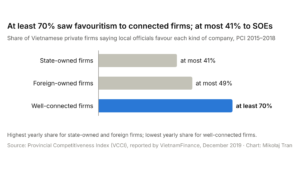
Since then, the pattern has softened, but not disappeared. The share of firms agreeing that government contracts, land and other resources mostly go to companies close to officials fell from 61% in 2021 to 55% in 2023. However, that is still more than half of respondents.
Earlier research by Malesky found that Vietnamese banks valued connections more than performance when deciding who got loans.
The PCI findings suggest that the distinction between state-owned and private companies tells only part of the story. Connections with officials appear to offer advantages that formal ownership cannot explain.
A semi-private railway
In May 2025, Vietnam’s Politburo (the Communist Party’s top leadership body) issued Resolution 68, calling the private sector “the most important driving force” of the economy. It also allows the state to favour private firms on strategic projects through “limited bidding or direct contracting” – handing out deals with little or no open competition.
Vingroup moved fast. A year later, Vietnam’s prime minister, Le Minh Hung, attended the start of work on a 120km high-speed railway between Hanoi and the coastal city of Ha Long, built by Vingroup’s VinSpeed for about $5.6bn. It is reportedly the first time a private company has led a major infrastructure project in Vietnam – work traditionally done by SOEs.
But the state never stepped away. When Vingroup proposed an even bigger railway project, running from north to south, sources told Reuters that officials had encouraged the company to bid.
However, the country’s central bank warned about Vingroup’s high debts and lack of rail experience, and said the project would need special state guarantees. Vingroup said it had not discussed any privileged treatment.
VinSpeed may be privately owned, but a project of this scale depends heavily on government decisions about financing, guarantees and infrastructure policy. Its independence therefore has practical limits.
However, perhaps the arrival of a privately owned railway in Vietnam might create a natural monopoly. Consumers might be at risk of discriminatory pricing. To what extent would this business take on the profit motive?
Closeness cuts both ways
Political favour can also be taken back. When the north–south railway proposal leaked in 2025, some analysts read the backlash as a sign that Vingroup may have lost some unspoken Party protection. At the end of the year, it dropped its bid.
The extreme case is property tycoon Truong My Lan, who was sentenced to death in 2024 for bribery and embezzling $12bn from a bank she secretly controlled. The sentence was later commuted to life imprisonment after Vietnam dropped capital punishment for certain crimes.
I live in Poland, which in 1989 changed its politics and its economy in one fell swoop. Vietnam has changed only its economy. Where elections and independent courts limit officials, ownership says a lot about who controls a company. Where they don’t, closeness to power matters more – and it can vanish.
So when you read that a Vietnamese company is “private”, ask a different question: not who owns it, but to whom it answers.

Edited by:

© 2026 The Oxford School for the Future