


17-year-old Filip analyses the new government’s likely approach to the EU and other countries
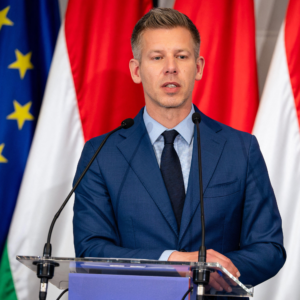
The Hungarian elections have finished, and they tell a story few thought was possible a year ago – Péter Magyar’s Tisza party won the election by a landslide, ending 16 years of far-right prime minister Viktor Orbán’s dominance.
Magyar persuaded the Hungarians he was not just another weak opposition voice but a genuine alternative – younger, more accountable, economically serious. Tisza’s platform combined anti-corruption messaging with promises of tax reliefs.
Let’s take a step back and see what the ousting of Viktor Orbán means internationally – for the European Union (EU), Ukraine and Russia, and the United States. Also, what is the greatest challenge for the new government as it aims to change the image of Hungary on the international stage.
View this post on Instagram
The EU exhales loudly
For those supporting a stronger relationship with the EU, the extent of Tisza’s victory is as big a surprise as it is a relief. Under Orbán, Hungary became synonymous with using its veto power to, for example, block aid packages for Ukraine, delay sanctions on Russia or hold up accession talks for Kyiv and Moldova. This behaviour effectively turned EU Council summits into negotiations over Budapest’s price for this or that solution.
The bloc’s 26 other members had grown visibly tired of a process in which one country of fewer than ten million people could stall decisions affecting 450 million.
Magyar has signalled a dramatic shift in all these fields – he has committed to restoring relations in Brussels, releasing Hungary’s hold on Ukraine funding and dropping opposition to EU-wide judicial and anti-corruption reforms. That alone would unjam the bureaucratic machine, releasing several files frozen for over a year, including the next tranche of the Ukrainian Facility and the mid-term revision of the EU’s 2021–27 budget.
However, Tisza is not a federalist party, and Magyar has been careful not to alienate socially conservative voters who abandoned Orbán’s party Fidesz on governance rather than ideological grounds. Except for Hungary remaining cautious on migration and new long-term budget and defence financing, analysts think Hungary’s relationship with Brussels will be strong.
Harbingers’ Weekly Brief
Subscribe to the Harbingers’ Weekly Brief, a newsletter written by the editorial board of Harbingers’ Magazine, the world’s youngest newsroom, delivered to your inbox every Monday morning.
![slide image]()
![author_bio]()
![author_bio]()


Budapest is now closer to Kyiv
Nowhere will the shift feel sharper than in Europe’s posture towards the war in Ukraine. Orbán spent the past four years positioning Hungary as Vladimir Putin’s most reliable mediator inside the bloc.
Orbán maintained energy contracts with Russia’s state energy corporation Gazprom, questioned sanctions against Russia and occasionally hosted officials when no one else would – such as the 2019 visit by Vladimir Putin to Budapest.
Magyar’s rhetoric has been markedly different. During the election campaign, he accused Orbán of being a “puppet of the Kremlin” and pledged to align Budapest with the EU consensus on Ukraine. In practice, that means dropping Hungary’s objections to the next sanctions packages (which officials in Brussels say include tighter enforcement against Russia’s shadow fleet and measures on evading existing sanctions through third-country intermediaries).
The change in power in Budapest also means a likely green light for reallocating frozen Russian assets towards Ukrainian reconstruction, a policy that Hungary has resisted until now.
Kyiv stands to benefit immediately: weapons transits through Hungarian territory, previously subject to political friction, should resume smoothly, and Hungary’s veto on opening Ukraine’s path towards joining the EU is expected to be lifted within weeks.
None of this will be frictionless. Hungary’s energy dependence on Russian pipelines is real and cannot be fixed quickly, and Tisza voters in the countryside are unlikely to accept sudden spikes in utility bills, especially given the already volatile situation resulting from the war in Iran. Similarly, Ukraine’s accession talks with the EU are lined with obstacles and difficulties.
However, the direction of travel has reversed – for the first time since 2022, the European eastern flank is aligned from Poland to Romania, and Vladimir Putin has lost a key ally inside the European Union.
Washington’s awkward morning
The trickiest shift may lie across the Atlantic. Orbán cultivated an unusually warm relationship with the second Trump administration, and in particular with figures such as vice president JD Vance, who publicly described Hungary as a model of “sovereign, rooted democracy” under Orbán and visited Budapest twice in the past year – including just days before the election.
Hungary became the European fixture of MAGA foreign policy, a counter-example deployed in speeches about wokeness, migration and the alleged decadence of Brussels.
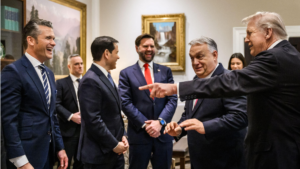

Magyar is not a natural ally of the Washington populist right nor does he lack empathy for the White House. His pitch has been pragmatic rather than ideological. Still, the symbolic loss is real.
The Trump administration can no longerpoint to Budapest as proof that Trump-style politics is winning in Europe. Instead, it will have to cope with the opposite narrative – that an anti-corruption centrist displaced a leader who Vance personally embraced.
After the Hungarian election, Marine Le Pen, the symbol of French far-right nationalists, saidthat her party should “keep their distance” from Donald Trump, as the current American administration became “toxic” for Europeans.
The adjustment may be gradual. The new government stated that they want a working relationship with Washington, particularly on trade and NATO’s eastern flank, where Hungary’s hosting of infrastructure matters more than politics. Magyar will probably maintain the country’s military spending commitment of more than 2% of GDP.
Whether Magyar can govern effectively as he campaigned remains to be seen, but the map of European politics looks different now.
The big economic ‘if’
The question now is whether those promises can survive contact with Hungary’s balance sheet.
Hungary enters this transition carrying one of the EU’s biggest budget deficits, projected above 4.5% of GDP for 2025. Furthermore, growth has been sluggish (barely above 1% last year), while inflation, though progressively decelerating, continues to bite household budgets.
Tisza has pledged cuts to VAT on basic goods and a significant reduction in labour taxes, measures Magyar argues will stimulate consumption and pull wages out of stagnation.
Economists are less convinced. Independent forecasters warn that without matching revenue increases or structural reform of Hungary’s exponential public sector wage bill, the cuts could push the government deficit above a staggering 5% of GDP, a territory that would almost certainly trigger EU excessive deficit procedures.
Tisza’s answer is to unlock roughly €20bn in frozen EU funds that Brussels has withheld over rule-of-law concerns. If the additional funds arrive, the arithmetics becomes survivable.
If it doesn’t, the new government will face the same question every Hungarian leader since 2010 has faced: who pays?

Edited by:

© 2026 The Oxford School for the Future