



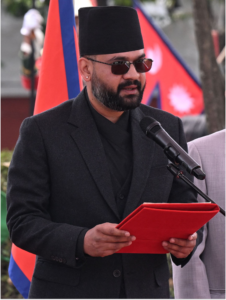
16-year-old Binita from the Nepali Newsroom reports on Balendra Shah becoming Nepal’s new prime minister
In a landmark event for Nepal, Balendra Shah, popularly known as Balen, became the country’s youngest prime minister at the age of 35 during an oath ceremony on 27 March.
A structural engineer by profession and the former mayor of Kathmandu Metropolitan City, Balen is also a rapper with more than 25 songs to his credit. Only the day before the swearing-in ceremony, he released a rap song titled ‘Jay Mahakaali’. It shattered the viewing record for Nepali music videos in just 24 hours, reaching more than five million views in three days.
View this post on Instagram
Another of his most popular songs is ‘Balidan’, from 2019, in which he raised the issue of misrule by old political parties, albeit indirectly. He also made remarks about government employees amassing disproportionate assets through corrupt practices.
Born on 27 April 1990, Balen originally hails from the Mahottari district of Madhes province in the southern plains of Nepal, and is the first Madhesi to hold the country’s top executive post.
His parents are Ram Narayan Shah (now deceased) and Dhruba Devi Shah. He is married to Sabina Kafle, a poet and writer, and they have a young daughter.
Balen has an MTech in structural engineering from Visvesvaraya Technological University in Bangalore, India and a bachelor’s degree in civil engineering from Purwanchal University in Nepal. He is currently studying for a PhD in engineering at Kathmandu University.
Harbingers’ Weekly Brief
Subscribe to the Harbingers’ Weekly Brief, a newsletter written by the editorial board of Harbingers’ Magazine, the world’s youngest newsroom, delivered to your inbox every Monday morning.
![author_bio]()
![author_bio]()


During his oath ceremony, 108 young Hindu priests and 107 Buddhist monks recited religious verses. This was the first time in Nepal’s political history that priests from both the Hindu and Buddhist religions recited religious verses during the PM’s oath ceremony. This has caused some controversy as Nepal is a secular country.
Less than 24 hours after assuming office, Balen launched a crackdown on former officials, with the arrests of former four-time prime minister KP Sharma Oli and former home minister Ramesh Lekhak.
Oli, who is also chair of the Communist Party of Nepal–Unified Marxist-Leninist (CPN-UML), was prime minister during the Gen Z protests on 8 and 9 September 2025. He was forced to flee after irate citizens went on the attack, while Lekhak resigned, taking moral responsibility.
Oli is the main person accused in the Gen Z killings linked to the events on 8 September, in which 19 youths lost their lives in a matter of a few hours.
In the 5 March election, Balen defeated Oli by a huge margin of 49,614 votes in the Jhapa-5 constituency, the former prime minister’s home turf.

The commissioninto the protests, led by former judge Gauri Bahadur Karki, has recommended criminal indictment against Oli, Lekhak and the inspector general of police, Chandra Kuber Khapung, under the homicide section of Nepal’s national penal code for failing to prevent the killings of Gen Z protesters.
Balen – who emerged as the most popular leader in Nepal after the Gen Z protests last September — joined the Rastriya Swatantra Party (RSP) only a few weeks before the House of Representatives election on 5 March. The RSP immediately made him the party’s candidate for prime minister.
Balen’s high profile and position as PM candidate helped RSP achieve nearly a two-thirds majority. RSP won 182 seats out of 275, thereby demolishing the myth created by the formerly dominant parties Nepali Congress and CPN-UML that, under Nepal’s mixed voting system,a single party cannot win a majority.

Edited by:

© 2026 The Oxford School for the Future