


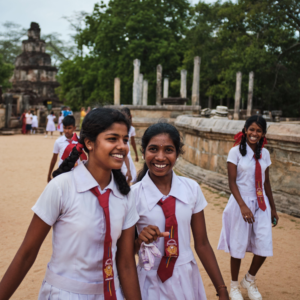
16-year-old Hesandi explains the causes and impact of period poverty in Sri Lanka
Despite menstruation being a normal part of girls’ and women’s lives, period poverty is still a major issue in Sri Lanka, especially in rural areas. This is driven by the damaging social stigma surrounding periods and the lack of affordable hygiene and healthcare.
Period poverty is the inability to access or afford menstrual products and it affects 50% of Sri Lankan households with menstruating women and girls. According to a 2018 study by WaterAID and UNICEF, 66% of girls in the country were not aware of menstruation until it first occurred. The average age for menarche (the first period) in Sri Lanka is between 12 and 14 years.
Although views on menstruation are starting to change among younger generations, periods are still considered a taboo topic among most people.
Harbingers’ Weekly Brief
Subscribe to the Harbingers’ Weekly Brief, a newsletter written by the editorial board of Harbingers’ Magazine, the world’s youngest newsroom, delivered to your inbox every Monday morning.
![slide image]()
![author_bio]()
![author_bio]()


Social stigma
Some cultural and religious beliefs in Sri Lanka view menstruation and menstruating women as impure. Some households follow a ritual during menarche: the girl is kept in an isolated room or makeshift hut, along with an iron object to ward off evil spirits, and away from any boys and men.
Two weeks after menarche, the girl is taken out of seclusion. An astrologer is contacted to decide an auspicious time for the “purifying bath”. A clay pot is filled with water and jasmine flowers (or milk and saffron in Hindu tradition) and poured over the girl.
This is to remove kili – an impurity that is believed to be around women when they menstruate. Such beliefs mean that women aren’t allowed in religious places or kitchens while they are menstruating.
After these rituals a large party is held, known as the Kotahalu Magula, where relatives and friends are invited to celebrate the girl’s transition into womanhood, even if she is still a child. In some cases, neighbours, family friends and even the parents’ co-workers are invited, which some see as controversial as the child is made to share a personal experience with complete strangers.
View this post on Instagram
Despite such celebrations, no effort is made by families or the Sri Lankan education system to educate these girls in a timely manner. Secluding young girls during their first period may cause them to miss school or important events, and be ostracised by their peers.
In many low- to middle-income families, girls experience menarche with a lack of knowledge and much misunderstanding, largely because the adults around them are misinformed as well. It is also frowned upon to talk about menstruation in front of men, and many women refrain from doing so for fear of being judged.
Personal experiences
Harbingers’ Magazine spoke to several women of different ages about their experiences and views on menstruation.
Padma, 82, told Harbingers’ that when she was a young girl, menstruation was heavily frowned upon and many girls were not allowed to step out of their rooms. “Thankfully, my mother knew that these rituals were pointless, so I didn’t have to participate in most of them,” she said.
She explained how she was not allowed to eat any meat, oily foods or several kinds of fruit as they were, mistakenly, believed to be the cause of cramps.
“I was 11 when I had my first period, and I was angry that I couldn’t eat whatever I wanted. I’m very glad that many people have abandoned these idiotic beliefs now,” she added.
She also mentions how menstruation wasn’t taught in school, which meant that many girls were frightened during menarche.
Ayana, 15, shared her experience as well. “I was around ten when it happened and I was scared because my mom wasn’t home,” she said. Her mother had told her some information about monthly bleeding, but she was still shocked.
Ayana’s school taught the basic facts, but not until she was 12 – and only as part of science classes, not as specific education on menstruation or puberty. She thinks that parents and schools should educate girls about periods earlier.
“I think it’s really stupid that people, even women, act so disgusted and shy around periods. Also, women shouldn’t be embarrassed when buying pads,” she said.
Harbingers’ discovered that many women believe that menstruation is extremely private and should not be spoken about. Many young girls feel too insecure to openly discuss periods, even with their female peers, and find menstrual products such as sanitary pads embarrassing. Bullying on the topic is also common in schools.
Lack of education
According to a 2025 survey of 417 individuals conducted by the Centre for Poverty Analysis (CEPA), 96% of respondents believed that girls should be taught about menstruation at school before menarche. The remaining 4% believe that children are too young and the mother is the one responsible for menstrual education.
Information on menstruation is only available online (not in books) and in the Sinhala language, making it inaccessible for Tamil-speaking students and those without internet access.
In addition, most teachers are uncomfortable teaching the subject and believe in many misconceptions themselves – for example, that bathing should be avoided during menstruation.
Lack of hygiene products
Menstrual products are a necessity, but they are inaccessible to a vast majority of women in Sri Lanka. They are expensive, especially imported items, which have a 51.07% tax on them.
According to the CEPA survey, 73% of respondents (mainly from high-income families) used only single-use menstrual pads, while 22% used both single-use pads and cloth, and 5% used exclusively cloth. Some 12% of respondents from lower income backgrounds used cloth exclusively, and were mainly older women.
Among those who used single-use pads, only 27% followed the medically recommended duration, indicating a lack of awareness or the resources to maintain proper hygiene.
Women who use old cloths often do not have access to clean water either, and use well water instead. This can lead to infections and even cervical cancer, which is the fourth most common cancer among women in Sri Lanka.
Misconceptions and some progress
According to the CEPA survey, many people believed that only women menstruate, revealing a lack of knowledge about transgender men and other queer individuals.

Misconceptions that don’t allow women to bathe or to eat high-protein food during their period in the belief that it will make the body smell bad and cause cramps can lead to disease and other health-related problems. Avoiding animal protein in puberty and during menstruation can lead to malnutrition and affect the proper development of hormones.
The Family Planning Association of Sri Lanka (FPASL), established in 1953, focuses on family planning and sexual reproductive health and rights. In 2023, it launched the Collective Action Against Period Poverty (CAAPP)project to improve access to menstrual hygiene and education and address the lack of facilities, especially in schools.
FPASL executive director Dr Ruchita Perera statedthat the project, which focused on rural and marginalised communities “marks a very important milestone”.
In 2025, the Sri Lankan government allocated 1,440m Sri Lanka rupees ($4.5m) to provide sanitary pads to schoolgirls in an attempt to fight period poverty. Although this is not a long-term solution to the problem, it is a step in the right direction.

Edited by:

© 2026 The Oxford School for the Future