



Laxman, 13, Pratima, 13, and Ramita, 14, from the Nepali Newsroom look at the key parties in next week’s election
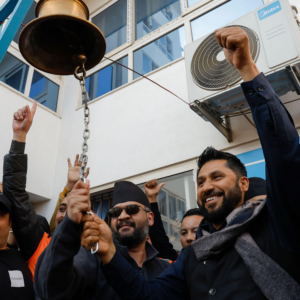
Balen Shah (in sunglasses) and Rabi Lamichhane, leaders of the Rastriya Swatantra Party.
27 February 2026
Nepal election 2026: Who are the main political parties?
In less than a week’s time, on Thursday 5 March, Nepal goes to the polls in a historic election following last year’s deadly Gen Z protests, which toppled the previous government.
Nearly 19 million people, including 800,000 first-time voters, are eligible to vote for 275 members of the House of Representatives via a mixed system of first past the post (FPTP) and proportional representation (PR). But who will they be voting for?
Harbingers’ Weekly Brief
Subscribe to the Harbingers’ Weekly Brief, a newsletter written by the editorial board of Harbingers’ Magazine, the world’s youngest newsroom, delivered to your inbox every Monday morning.
More than 3,400 candidates from almost 70 parties have registered for the election, according to Nepal’s Election Commission, the official body responsible for organising and monitoring elections in the country. It is highly likely that the new government will again be a coalition, as has been the norm for many years.
Below, Harbingers’ Magazine summarises the seven most important political parties, based on their previous performance and current popularity.
Other parties include the Janata Samajwadi Party-Nepal (JSP-N) and Janamat Party. Although limited to regional politics, they often play a significant role in the creation of the central government. In the last election, JSP-N won 12 seats, while Janamat won six.
Harbingers’ Weekly Brief
Subscribe to the Harbingers’ Weekly Brief, a newsletter written by the editorial board of Harbingers’ Magazine, the world’s youngest newsroom, delivered to your inbox every Monday morning.
![author_bio]()
![author_bio]()
![author_bio]()
![author_bio]()

Rastriya Swatantra Party
The RSP has become one of the most prominent parties in Nepal’s new political landscape. It was registered with the Election Commission on 1 July 2022 by former TV presenter and journalist Rabi Lamichhane.
The RSP won 21 seats (10.7%) in the House of Representatives in the last election, in 2022, which surprised many since it had only formed a few months earlier. It even took part in the coalition government, but changes in the coalition and cases against Lamichhane harmed the party’s reputation.
However, last year’s Gen Z revolution has given RSP another opportunity. This is mainly due to the popularity of prime ministerial candidate Balen Shah, who joined the RSP in January as a senior leader and is the most trusted person by Gen Z leaders.
The centrist party became popular as an alternative to traditional forces in Nepal, focusing on honest leadership, fighting corruption and selecting capable people of leadership. As a result, some people are anticipating that the RSP will win a majority and form the government.
View this post on Instagram
Nepali Congress
The social democratic Nepali Congress is the oldest political party in Nepal, founded in 1950. It is known for its role in bringing democracy to the country and is currently the most important political force, with a membership of more than 870,000.
In the 2022 election, Congress emerged as the largest political party with 89 seats (25.71%) out of 275. It was in the coalition with the communist CPN-UML at the time of the Gen Z revolution last September.
Following infighting and turmoil in Congress, 49-year-old Gagan Thapa was elected unopposed at the party’s new leader in January, at a special general convention in Kathmandu.
View this post on Instagram
CPN-UML
The Communist Party of Nepal (Unified Marxist-Leninist), commonly known as CPN-UML, was established in January 1991. It was the second largest political party in the 2022 election, with 78 seats (26.95%).
Its president, KP Sharma Oli, was prime minister during the time of the Gen Z revolution and was ousted as a result, leading to the current interim government and the upcoming election.
Although the party was popular before the 2022 election, there is increasing frustration with it now, especially among the youth vote. Despite Oli’s downfall after the September protests, he was re-elected for a third term as head of the party last December.
The RSP’s Balen Shah is directly challenging Oli in his home constituency of Jhapa-5.
View this post on Instagram
Nepal Communist Party
The NCP was formed in November 2025 following the Gen Z revolution. Several communist and left-wing elements, including the CPN (Maoist), which won 32 seats in the 2022 elections, and the CPN (Unified Socialist), which won 10, merged to form the new party.
The main leaders are Pushpa Kamal Dahal, who previously led the Maoists , and Madhav Kumar Nepal, former president of CPN (Unified Socialist). Both are former prime ministers of Nepal.
View this post on Instagram
Rastriya Prajatantra Party
The RPP is the main right-wing political party in Nepal, with the restoration of the monarchy and Hindu nationalism as its main priorities.
Founded in 1990 and currently led by Rajendra Lingden, the culturally conservative party is backed by the former king Gyanendra Shah, a controversial figure due to his occasional interventions in the country.
The RPP won 14 seats (5.58%) in the 2022 election. This time around, it seems to be in a comfortable position and is likely to bag some seats.
View this post on Instagram
Ujyalo Nepal Party (UNP)
The UNP is a new political party formed after the Gen Z revolution. The party is led by Kulman Ghising, an engineer by profession and a former minister in the interim government, responsible for energy, water and irrigation. He is famous for eliminating “loadshedding” (power outages) in Nepal – the party’s symbol is an electric light bulb.
The UNP initially merged with the RSP, but soon split due to differences. The party, which has 112 candidates in the election, has promised several economic reforms.
View this post on Instagram
Shram Sanskriti Party
The SSP is a new grassroots nationalist party, founded in November 2025. Its name means “Labour Culture Party” and the party symbol is two hands holding soil. Its main agenda is labour rights, localism and a self-reliant economy.
The party’s leader is Harka Sampang Rai, the former mayor of Dharan, known for his community-led infrastructure projects, notably the successful mobilisation of volunteers to solve the city’s water shortage. But he is also a controversial figure who has got into trouble due to his random posts on social media and accusations against other political parties and groups.
The SSP is fielding candidates in 110 out of 165 constituencies across the country.
View this post on Instagram

Edited by:

© 2026 The Oxford School for the Future