


Samuna, 16, Binita, 16, Rakshya, 14, and Laxman, 13, from the Nepali Newsroom explain how the catastrophic flooding has affected their country
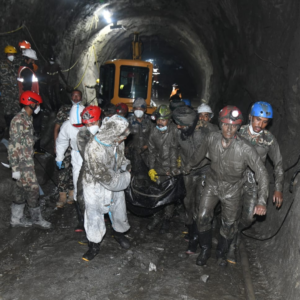
Nepali Army rescue operation in one of the tunnels along Trishuli river in Nepal
9 October 2026
Nepal’s deadliest disaster in years: Thousands killed in flooding
On the morning of Wednesday 26 August, a glacial collapse occurred near the Nepal-China border. This sudden collapse triggered violent flash floods that ripped through the Bhotekoshi and Trishuli river valleys in the northern part of Nepal. The disaster has taken more than 1,450 lives and 5,600 people are still missing.
The disaster happened in the country’s mountainous northern border region, specifically in the three districts of Rasuwa, Nuwakot and Dhading. It affected thousands of local residents, labourers working in hydropower tunnels and more than 600 foreign tourists. At least 11 helicopters and rescue teams have saved over 300 foreign tourists.
According to government data, more than 13,700 people have been rescued so far, and over 1,100 people are staying at various holding centres. The government has deployed more than 20,000 security forces in search and rescue operations, which have been active for over a month now.
Harbingers’ Weekly Brief
Subscribe to the Harbingers’ Weekly Brief, a newsletter written by the editorial board of Harbingers’ Magazine, the world’s youngest newsroom, delivered to your inbox every Monday morning.
![author_bio]()
![author_bio]()
![author_bio]()
![author_bio]()
![author_bio]()


According to UNICEF, the disaster has directly affected over 84,000 people, changing lives across the country.
Prime minister Balendra Shah is handling this massive crisis by launching a multi-agency emergency. The government has established a mechanism for families unwilling to stay in holding centres. A monthly allowance for accommodation and livelihood will be provided until alternative housing is arranged, for a maximum period of six months, at a rate of 15,000 Nepali rupees (approximately $100) per family of four.
Dharam Raj Uprety, chief executive officer of the National Disaster Risk Reduction and Management Authority, said that the scale of the flood was beyond their imagination.
“We assumed it was an ordinary flood, but the scale of the damage and reports shocked us,” he said during an event in Kathmandu.
Reactions from local people
Harbingers’ Magazine interviewed several eyewitnesses and people who have visited the affected area to understand the impact of the most devastating disaster in decades to hit Nepal.
Jharana Nepali, 22, said the recent flood was very dangerous and on a massive scale. She felt very bad because hundreds of children and people were impacted, and many children were separated from their families.
It reminded her of the devastating earthquake in 2015 that claimed over 9,000 lives and destroyed her home completely; she was homeless for at least six months. She felt very bad for the children who lost everything in the flood.

“A lot of children in our orphans’ home were rescued from different districts of Nepal, so if it is possible to rescue them [children affected by the flood] into our home, it will be better. The door of our home is always open for them and others,” she said.
Similarly, Krishna Manandhar, 25, said that at first he thought the flood was not dangerous, but he realised how catastrophic it was as he saw more and more visuals. Manandhar, who also works at an orphan home, was shocked after seeing the reports when he saw his orphan home brothers and sisters face them.
Sandip Gurung travelled with his brother to the flood-impacted area in Rasuwa district, on behalf of a charity. He spent a week distributing food, as most of the local drivers and engineers had died in the flooding. He said, “The situation there was very difficult and there was a foul smell of dead bodies in the river.”
The first priority were families who had lost members, and then the marginalised Dalit community, said Gurung. Children who lost both their parents were housed in a school run by the government. Many local facilities had been damaged, so it was useful to provide technological help as well as food.
Nepal’s vulnerability to natural disasters
In recent years, natural disasters such as floods, landslides and extreme rainfall have increasingly threatened communities, infrastructure and livelihoods across Nepal. When decades of warming cause mountain slopes to suddenly collapse, disasters like this can strike Nepal within hours and wash away lives in a matter of minutes
The Himalayas are warming faster than the global average, causing glaciers to melt and increasing the risk of glacial lake outburst floods (GLOFs). These climate changes are causing serious climate-related losses and damage.
View this post on Instagram
According to the World Weather Attribution (WWA), Nepal is particularly exposed to climate-related catastrophes due to its mountainous geography and limited capacity to cope with disasters. Changing rainfall patterns, intense monsoon precipitation, extreme heat and other climate stresses are increasing risks to people and the environment.
Although the WWA report clearly mentioned global warming as the reason for the recent catastrophic events in Nepal, additional evidence is needed to state human-induced climate change as the explicit reason for the floods.




Edited by:

© 2026 The Oxford School for the Future